Posting Killifish
Do you believe in miracles?
Yes, with modern technology and dedication miracles can be achieved in our hobby. Posting of eggs have been done in the last 50-55 years and the good results is seen everywhere. Posting of live fish have followed a few years later. This was soon followed by posting live fish overseas too with good results. In the early years, we use to put enough water to immerse a single fish and then add air or pure oxygen if that was available. So the bags were very large and only a pair or two could be put in a small cardboard box. Also, the fish had a lot of swashing during delivery and many of the fish used to arrive in very bad condition.
The first time I posted fish from Malta to an AKA Convention was in 1974 which was held in Oregon, Portland. At that time, I did not know that the place is on the Pacific Coast. I won a ribbon for 3rd place and it is one of my treasures. The following year I send pairs to Long Island and again won a Judges award and the year after, I sent fish to Detroit again winning 3rd. Then I moved home and was too busy to post fish. I believe that those days, deliveries were much faster as there was no danger of bombs being sent through the post.
I also used to send fish to the BKA Conventions and among other trophies I won, was Best in Show, Best Foreign Entry and 1st Place for a pair of Aphanius dispar Richardsoni. The only disappointment I have is that on the only occasion I attended a BKA Convention in 2007, I did not win any prize. In the meantime, I kept posting live pairs to many hobbyists in Europe.
In the beginning of this century, breather started to hit the market, though Kordon says that it has been doing these bags since 1961! These bags were a little large for small fish like the ones we keep and expensive too,
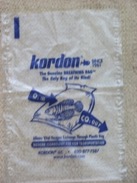
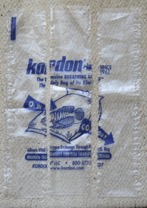


with each bags costing over $1.00 to reach my home. In the last 10 years, these were copied in China (Longlife) and for the same price, I get 4 bags with free P&P.
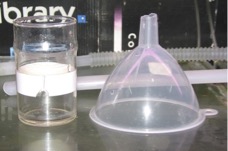
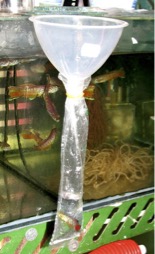
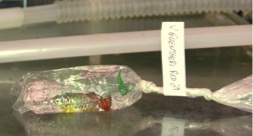
I still believe that the bags manufactured by Kordon are of better quality. Still the smallest size of any of the ones available is still too large to ship live fish. So I cut each bag into 2 or 3 portions and double weld again from the long sides again, making small bags. For small fish, like Nothos., I measure 63ml (quarter metric cup) of filtered aged water and put the fish in the cup. Then to pour the fish into the bag, I use a plastic funnel as it is not possible to pour the water and the fish into these small bags. Then I make a knot and another one further up. In between the knots, I put a label with the fish species name and sex. When posting live fish to Europe, I usually use Long Life breather bags that are made in China. For large fish like Fundulopanchax sjoestedti, I cut the original bags into two.
I use styrene mug boxes to post fish in and these can hold between 4 to 6 pairs. Care should be taken not to let the bags touch with each other as this prevents them from breathing air. So I wrap each bag in tissue paper and after I seal the box with strong tape, I leave a hole on each side of the box so that air can penetrate the box and reach the bags with fish. A box with 4 pairs weighs around 500g and when at the post office, I always pay for tracking. On the customs declaration I write “Specimens for Scientific Studies. Gift. No Commercial Value. This helps the buyer in not paying any charges and also gets cleared from customs as it is prohibited to send liquids through the post.
But putting a live fish in a small bag requires a lot of expertise so I do this with a plastic funnel and after putting the fish in the beaker, I put the funnel funnel`s end into the top of the bag and pour the water and the fish into the bag. Then I tie a knot and another knot further up. The second knot is there to prevent any water leakage from the first knot. Then I put a label with the species name and sex.

To come to my story now. Usually posting a packet on a Monday morning to the UK is delivered by Thursday. The same applies to Germany and most EU countries. Exception to Ireland and Spain where deliveries might be the following Monday or Tuesday. The exception is posting to Italy, the nearest country. If the packet is not registered this is delivered after 10 days and if tracking id pair for, delivery might take as long as 17 days. This is what have happened when I posted 4 pairs Aphanius farsicus to Gabriel Simion. Using tracking, I could see that the packet was in Milano, Italy just after 3 days after posting it and it took another 14 days to be delivered. Me and Gabriel exchanged many messages daily hoping that the packet gets through and after 14 days he asked me if there is any chance that the fish will survive. I replied that only a miracle would save the fish. After 17 days, he wrote to me saying that the packet has been delivered and that 7 out of 8 fish have survived. I replied saying that it is a miracle!


10 days ago, I posted another box with the same pairs to Taiwan. I had told the buyer that the journey is too long and so far, I could not track the packet but still, after this experience, I have hope that another miracle might happen. Updated 13th October at 8.00pm; Fish arrived in Taiwan in very good condition, I am told. In this shipment, I used Kordon breather bags. Another update on 10th November; Fish posted to Israel on 31st.October were delivered today after 11days in the post. 7 fish survived and one died because the bag leaked.
12/10/2016
Charles Zammit
Malta.
There are currently 2 couriers that you can use to post Fish within the UK
DX and APC Royal Mail no longer take live fish
AKA Zoom Oct 18 2020 Posting Killifish Sarah Walker [YouTube]