Beginning with Killies
by Richard Cox
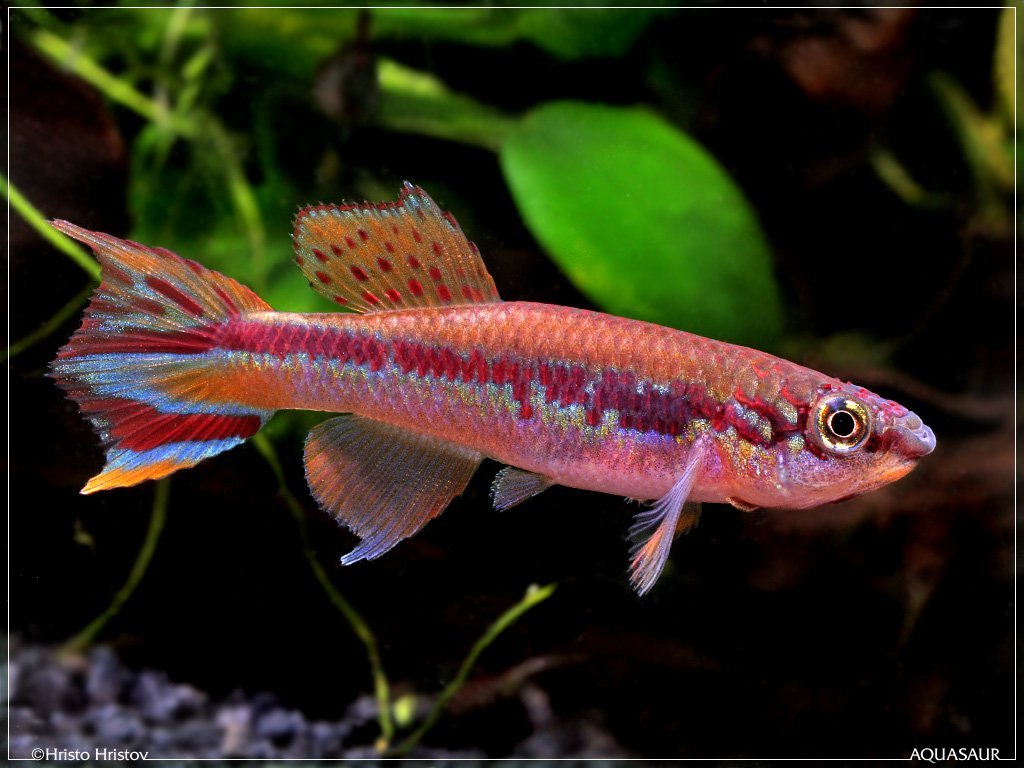
In this short article I will try to give a simple introduction to killifish keeping and at the same time explode a few myths about killifish and their needs. Firstly, let us discuss what we mean by the term killifish. It in fact embraces a group of fish of the family Cyprinodontidae which are commonly called the egg-laying toothcarps They are found within the equatorial belts throughout the world and differ greatly from continent to continent. In simple terms they are divided into three main groups: the annuals, semi-annuals, and non-annuals. The annuals live in the wild for a single season, hatching from eggs deposited in the mud of a dried-up pond, growing and breeding before the pond again dries. Semi-annuals live in areas which sometimes dry out but at other times retain water through the dry season. The non-annuals live in permanent bodies of water and, in some cases, will live for anything up to five years. As an example of the great differences between the same groupings in different continents, the annual Nothobranchius of Africa are entirely different from the annual Austrolebias of South America. Such differences are to be found in the other genera throughout the world.
Now, perhaps you, like me, have always been interested in killies but have never been too sure about specialist associations due to lack of information. This situation faced me over ten years ago. I had been keeping and breeding fresh water tropicals with moderate success. I then ventured into the killie world via the organisation I belong to to this day and have never looked back. I have been continually fascinated by these beautiful and extremely hardy creatures. Truth to tell, I found that most species are infinitely easier to keep and breed than a lot of tropical species. In fact, if a species is kept alone in a well-established tank, they will virtually look after themselves and reproduce at a steady rate for good measure.

Aquarium requirements
In the wild a lot of species are territorial by nature, the male defending his area against intrusion by other males. They mate with whichever females they can tempt into their territory, but of course some species shoal and will not satisfactorily reproduce unless kept in similar conditions.
In the main however, they can be kept in pairs or one male with two or three females. Accordingly, they may be kept in relatively small tanks compared with other fish of similar size. A tank measuring 12 in. by 8 in. by 8 in. will house a pair or trio of killies, in fact up to six of the smaller sized species can be kept and bred in a tank of this size. As a rule of thumb species under two inches in length will be happy in a tank of the above size, species of up to four inches, in a tank size of 18 in. by 10 in. and the larger species, such as Fundulopanchax sjoestedti, should be housed in a 2 ft. tank. Not everyone will agree with these sizes, but if you want good size and good quality fish (and who doesn’t?) the larger tanks usually produce larger specimens. Most killies in the wild are found in shallow water so the depth of the tank is not important. A depth of 6 in. is adequate but a closely fitting lid is essential. Killies are excellent jumpers and if you leave a gap in the lid I promise you they will find it. A lot of rubbish is often talked and written about water conditions for killies. Certainly, in the wild most are found in soft, slightly acid water. However, experience has shown that they can be quite satisfactorily kept in whatever conditions are provided, within reasonable limits. The most important thing to remember is to acclimatise species to your conditions very gradually. I know that there is a desire to get new fish into a tank quickly, but this could be the death of them. Sudden changes of water conditions can cause gill injury or death due to shock, so do please take care.
Provided you follow this advice, most killies will accept very hard alkaline conditions, but I don’t for one minute pretend that they will reproduce in them. You may well find that you will have to soften and acidify the water before some species will breed. But again, some species, such as the Epiplatys genus, will breed in nearly all conditions. So, in relation to water, make up your mind what you can provide and stick to it.
Don’t tackle the more difficult species until you have mastered the easier forms. Personally, I have always used aged rainwater to which peat has been added for a short time. A word of warning here: always boil the peat before using it, thus removing a lot of the brown stain which leaches out into the water in too great a quantity if it is not boiled. The water, when ready for use, should be tinged slightly brown. To prevent disease, I also add a teaspoonful of cooking salt to each gallon of water. I have always done this and have never suffered from any major outbreak of disease.
The question of tank decoration is a matter for the individual. Killies can be kept in bare tanks with a nylon wool mop as an egg spawning site. Merely bundle thirty or so strands of nylon wool, cut to 12 in. lengths, together, fold them in half and tie either a cork or other floating object in the centre and you will have a very useable spawning mop. How-ever, you may prefer to keep planted tanks, in which case always be careful to select the right plants for the right conditions. Plants needing soft water will soon die in hard conditions and vice-versa. For years I kept bare tanks with either mops or Java moss as a spawning medium but in recent times have come to prefer planted tanks. I find that most killies breed perfectly well without any interference from me and will continually produce a stream of youngsters if kept well fed. They also display better colouring in a more natural environment. However, this is a matter of personal choice. When dealing with annuals and semi-annuals the requirements are somewhat different. In the case of annuals only one male per tank will be possible as males tend to be very aggressive towards each other. They are better kept in a bare tank with just some cover for the females to hide in as males can also be very aggressive towards the females. They are hard drivers so try to aim at a ratio of two or three females to each male. But, in any event, do watch them closely. As a spawning medium I suggest boiled peat, although it has the disadvantage that the eggs are somewhat difficult to find. Place the peat in an 8 oz. size margarine tub, or similar container, with a hole of about 14 in. cut in the lid to allow the fish to enter and leave. With semi-annuals either method will usually bring results. They will spawn in either mops or peat fibre or both. So bare or planted tanks can be used provided that, in the case of planted tanks, the spawning medium is removable to collect the eggs for ‘dry’ storage.

Temperature
On the question of temperature killies prefer a much lower range than the average tropicals. In fact, if they are kept at too high a temperature, they will soon let you know that they do not like it. Aim for a temperature of between 68° and 74°F. Only in a few species does a higher temperature have to be used.
Feeding
In the wild killies eat mainly terrestrial insects, aquatic insects, larvae, and crustaceans. Accordingly, they do better on live foods, but they will eat dry foods provided they are supplemented by live foods or high protein food such as minced beef heart. Favourites with killie keepers are Grindalworms, Whiteworms and Tubifex worms, although I personally do not recommend Tubifex as I feel that they tend to foul small tanks quickly, wingless Fruit-flies, Daphnia, Cyclops and a favourite of mine, Bloodworms. Seldom will killies eat more than when bloodworms are provided. I try to feed these once-a-week good quality flake food can be given but do so sparingly. Remember you are usually only feeding two or so fish as opposed to the usual tankful. Many other foods can be used and are readily taken.
Breeding
Non-annual species can be dealt with in two ways. Firstly, they can be left well alone in a planted tank and, provided cover is made available for fry, they will usually come to no harm left with the parent fish. Secondly, the eggs are harvested from the mops and incubated in small containers. Most hatch between 10 and 30 days after spawning, provided they are kept at the appropriate temperature. On hatching most fry need Infusoria (these are the small, microscopic creatures found naturally in water) and can also take newly hatched Brine Shrimps and Microworms. Always be careful not to overfeed, especially Brine Shrimps which quickly foul the water in the incubation containers. A lot of killie keepers use 8 oz. size margarine tubs for this purpose so you can see that fouling must be avoided. If too large a container is used the fry have difficulty in finding food and, thus, starve. In most species growth is moderately slow but sure and a lot will live for three to five years. As they increase in size move them on to larger containers until by the time, they are half an inch long they can be transferred to an 18 in. by 10 in. tank. With semi-annuals, I find the best method is to collect the eggs, don’t worry about handling them as they can withstand considerable pressure. Store them on moist peat at the required temperature. By moist I mean more wet than that described for annuals. Add water until you can see it between the particles of peat. Just place the eggs on this and you can watch their development with a hand magnifier. The fry inside the egg will usually tell you when it is ready to hatch. As a rule, when you can see the fry’s eye clearly then it is ready to hatch. Return the eggs to water and they should hatch within four to ten hours. Often, some will hatch within minutes of being returned to water. Feeding the fry is the same as for non-annuals but growth is very much quicker, so food requirements are greater. Only experience will tell you how much to give.
The eggs of most annual species must be ‘dried’ and stored for anything between six weeks and nine months depending on the species. What do we mean by dry? Well by dry I mean damp, aim for the same dampness of freshly opened tobacco. Remove the peat from the spawning container using a fine mesh net to hold it. Then gently squeeze out all the surplus water. You will not harm the eggs. When all the surplus water has been removed place the peat and eggs into a plastic bag and seal and mark it. Then store for the appropriate period at a temperature of about 80°F. A high shelf in the fish house or an airing cupboard will be suitable. When returning the eggs to water always be sure to add salt as a lot of annuals are prone to velvet so precautions are a must. After hatching they grow at a fantastic rate, and some can spawn after only six weeks. They require a large amount of food but again do be careful not to overfeed. If the eggs of either annuals or semi-annuals fail to hatch, then re-dry them for two weeks or so and try again. In fact, several waterings will be needed to hatch all the eggs due to what is called diapause. This is the ability of certain eggs to suspend development, and, in this way, ensure that, if the first rains are only brief, then eggs will remain unhatched to await the second rains.
Conclusion
There is nothing mysterious about killifish or the organisations which are dedicated to their advancement. They are no more difficult to keep and breed than any other tropical species. The only difficulty is in obtaining species. The average aquarist dealer cannot obtain stocks and, when they do, the price is usually very high. Within the organisation in this country there are usually 50 to 100 different species readily available to members. Well, there you have it. In the space available I have tried to give a general but as full as possible introduction to killie keeping. I sincerely hope that some of you will be encouraged to venture into the world of killies and enjoy this aspect of fish keeping.
Here are a few species of the three groups which are considered suitable for the beginner:
Non-Annual: Aplocheilus panchax, Aplocheilus lineatus, Aphyosemion ahli, Aphyosemion calliurum, Aphyosemion striatum (possibly the best for colour and ease of breeding) Pachypanchax playfairii, Epiplatys bifasciatus, Epiplatys sexfasciatus (most populations), and Epiplatys roloffi
Semi-Annual: Fundulopanchax gularis, Fundulopanchax ndianus, Fundulopanchax marmoratus, Fundulopanchax puerzli, Fundulopanchax amieti and Fundulopanchax gardneri (although some populations are non-annual).
Annual: Nothobranchius foerschi, Nothobranchius kirki, Nothobranchius palmqvisti, Nothobranchius guentheri, Nematolebias whitei, Austrolebias nigripinnis, Austrolebias bellottii, Fundulopanchax filamentosus, Fundulopanchax robertsoni and Fundulopanchax deltaensis.
Of course, there are many more this being only a small sample.
NOTE: This article was originally published in June 1984 for Aquarist and Pondkeeper magazine. Sadly some of the easy species Richard talks about will now be difficult to find.