Oditichthys ornatus
ODITICHTHYS ORNATUS
Originally published as: “Rivulus ornatus” B.K.A. Information Pamphlet No.106 September 1976
Biotope: Reportedly from Obidos, Silva and Cudajas in the Amazonas.
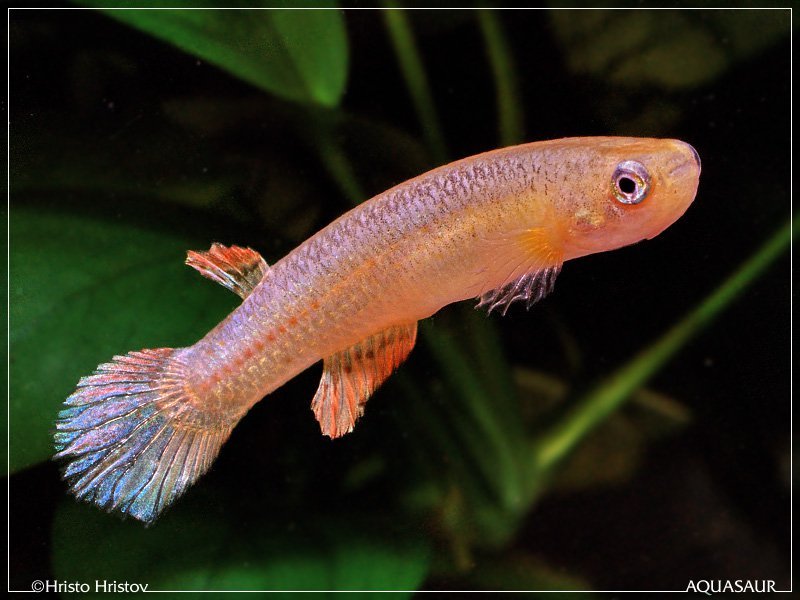
Description of Male: Body light tan dorsally shading to dark tan on the flanks, underside pinkish to orange. The sides are suffused with iridescent tones of pink, bronze and lavender, and sprinkled with red dots. In young specimens these dots sometimes form horizontal rows extending from the operculum to the caudal peduncle. The dorsal and caudal fins are deep orange with the dorsal having a zig-zag line composed of red dots running horizontally across the fin, this line being approximately one third the length of this fin from the body. The anal is lemon yellow at the base, shading into deep orange throughout the outer two-thirds of this fin. The pectorals are clear and the ventrals yellow to orange. The eye is bold and, under certain lighting conditions, appears to have the same light-reflecting properties as the Micropanchax.
Size of Male: To 2 inches.
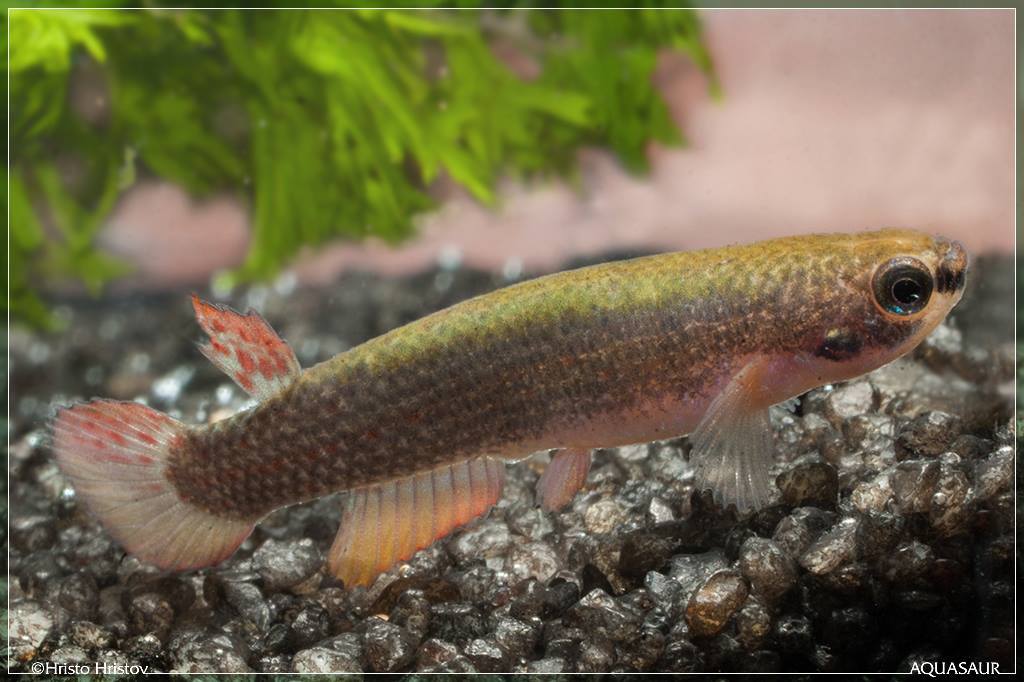
Description of Female: The fins are clear, and the body is tan overall, with the undersides being a dirty white colour. The red dots are completely absent, and the caudal peduncle carries the ‘Rivulus spot’ a single small black dot on a white background. When frightened or ill at ease the female displays a peculiar colour pattern. The upper half of the body, from the dorsal fin forward, assumes an almost black hue while the lower half, from the rear of the gill covers to the caudal, appears light grey to white.
Size of Female: To 1.5 inches.
Maintenance and breeding: This species is well suited to small aquaria, a 12″ x 6″ x 6″ tank being quite ample for a pair or trio. They are not fussy eaters, accepting dried foods, beef heart and suitably sized live foods with equal relish. Water conditions are not critical, a hardness of 5 to 7 degrees German and a pH ranging between 6.0 and 7.4 sufficing nicely. They can be propagated using mops with the eggs being collected and incubated separately, or they can be ‘flock’ bred. If the latter method is chosen a somewhat larger tank, containing a dense covering of Riccia or other floating plant, is recommended. This will supply the fry with sufficient cover during the first few weeks of their lives, when they are most apt to be regarded by the adults as tasty titbits. The eggs are about 1.5mm in diameter and hatch in 14 to 21 days at a temperature of 75F. The fry are 1/4 inch long at birth and should be fed Liqu-fry, microworms, and finely powdered dry food. They can consume newly hatched brine shrimp in two days, grindal worms in one week, and small tubifex and beef heart at three weeks of age. The males begin to show colour in the fins in six to eight weeks and the ‘Rivulus spot’ appears on the females some three to four weeks later. They attain full size at six months of age and are sexually mature at this time.
Summary: One of the more attractive members of the genus, easily cared for and propagated. The only problem associated with this species concerns the sex ratio, some 90% of the offspring being males.
References:
https://www.itrainsfishes.net/content/rivulus_ornatus_001.php