Nothobranchius kirki
NOTHOBRANCHIUS KIRKI (Jubb, 1967)
Nothobranchius kirki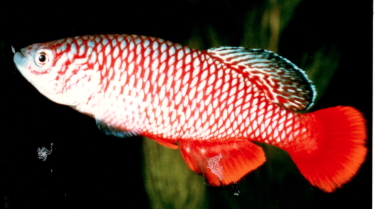
Originally published as: B.K.A. Information Pamphlet No.72 1982
First Description: The Nothobranchius (Pisces Cyprinodontidae) of Southern Africa and a new species from Lake Chilwa, Malawi. Ann. Cape Prov., Mus. (Nat. His.) 8(1) 12-19.
Meaning of Name: Names in honour of its discoverer, R.G. Kirk who found the first specimens in a pool close to Lake Chilwa in 1966.
Systematics: FAMILY: Cyprinodontidae
SUB FAMILY: Rivulinae
GENUS: Nothobranchius
SUB GENUS: Zoonothobranchius
Synonyms: Nil
Meristic Data: D = 15-17 A = 15-18 D/A = 0 Code KIR
Total Size: 50mm.
Distribution: Found in temporary pools and swampy areas with thick vegetation bordering Lake Chilwa, Malawi.
Maintenance: This species is, in its general requirements, typical of most other members of this genus. It appears not to be fussy about water conditions although, having said that, if kept in alkaline conditions it is not so prone to attacks of oodinium (velvet) and fungus. To reduce the likelihood of such attacks it is suggested that sea salt crystals or non-iodized salt be added to the water at the rate of one teaspoonful per gallon. As with most other species, should a change of water conditions be undertaken then such changes should always be very gradual.
N.kirki will do well in a tank of about three gallons capacity to which peat fibre or mops should be added as cover for females, as the males do tend to ‘drive’ rather hard when spawning.
This species will eat almost all available proprietary brands of dried food and the usual live foods. However it does show a distinct liking for blood worms, the larvae of the common midge Chironomus. They are said to contain rich amounts of vitamin B12 which, according to at least one authority, is the only vitamin essential to the well being of fish.
Water should be changed at least every two weeks with at least a quarter being replaced with fresh. Any medium should likewise be replaced thus avoiding any build up of waste matter leading to disease. In aquaria they seem to thrive at temperatures in the lower seventies but are capable of withstanding much higher temperatures in nature. When first collected the pool temperature was 88F.
Breeding: N.kirki is a member of the substrate ‘ploughers’ in that they lay their eggs in the top layer of detritus at the bottom of the pool. To effect this the pair adopt the characteristic ‘S’ body position with the male clasping the female over her back with his large dorsal fin thus pressing her into the spawning medium. Accordingly a pair should be provided with fine well washed and boiled peat. For ease of handling it is best placed in a container, such as an eight ounce size tub, with a hole cut in the top sufficiently large for the pair to enter and leave with ease. Eggs will be deposited over a period and the contents should be removed and dried and replaced with fresh peat every two weeks. Now volumes +have been written about how dry, dry actually is. It is something +gained with experience but if the peat is allowed to dry to the texture of tobacco then it should be about right. Mark the bag in which the eggs are stored and keep them in a warmish place for the required period which, in this case is anything between three to five months. Examine the eggs regularly and as soon as they ‘eye up’, that is the eye of the fry can be seen inside the egg, then return them to water. On hatching the fry will be capable of taking artemia nauplii (brine shrimp) or microworm and with careful management will grow quickly and start sexing out after about four weeks. The peat can be re-dried for a further month when more fry can be expected to hatch.
Summary: A very beautiful species which at last is beginning to become more widely distributed throughout the hobby. The species depicted in this information pamphlet is designated U1 to distinguish it from a very similar, darker coloured fish, referred to as N. cf. kirki U8 which hails from Selima on the shore of Lake Malawi. Great care should be taken to avoid crossing the two forms.
References:
https://wildnothos.wixsite.com/wildnothos/kirki