Nimbapanchax petersi
NIMBAPANCHAX PETERSI (Sauvage 1882)

Originally published as: “Roloffia petersi” B.K.A. Information Pamphlet No.69 April 1971
An attractive and strangely little known killie from West Africa, this species has been kept by British aquarists for many years without ever attaining the popularity that its colouration and peaceful behaviour so richly deserve.
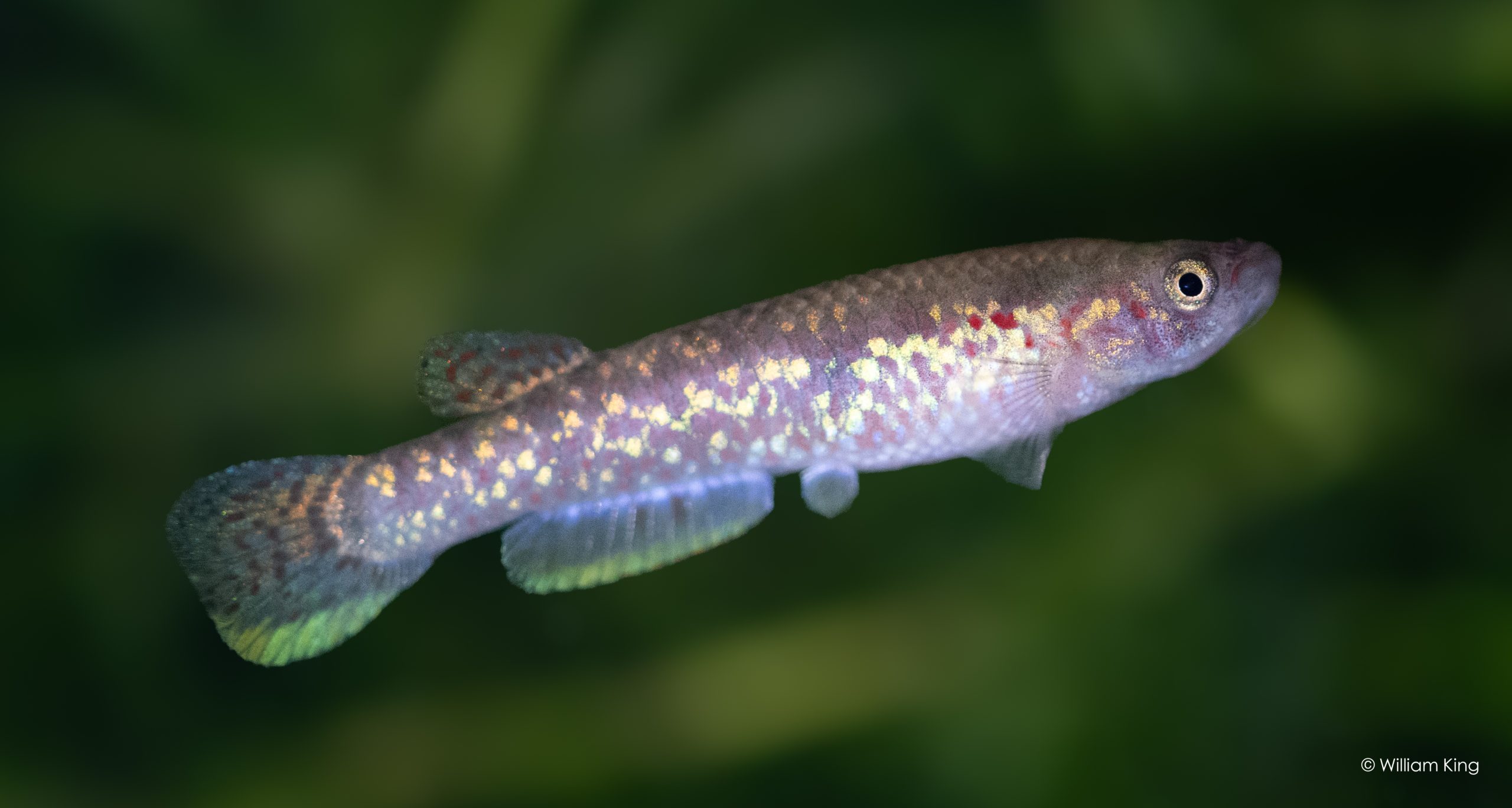
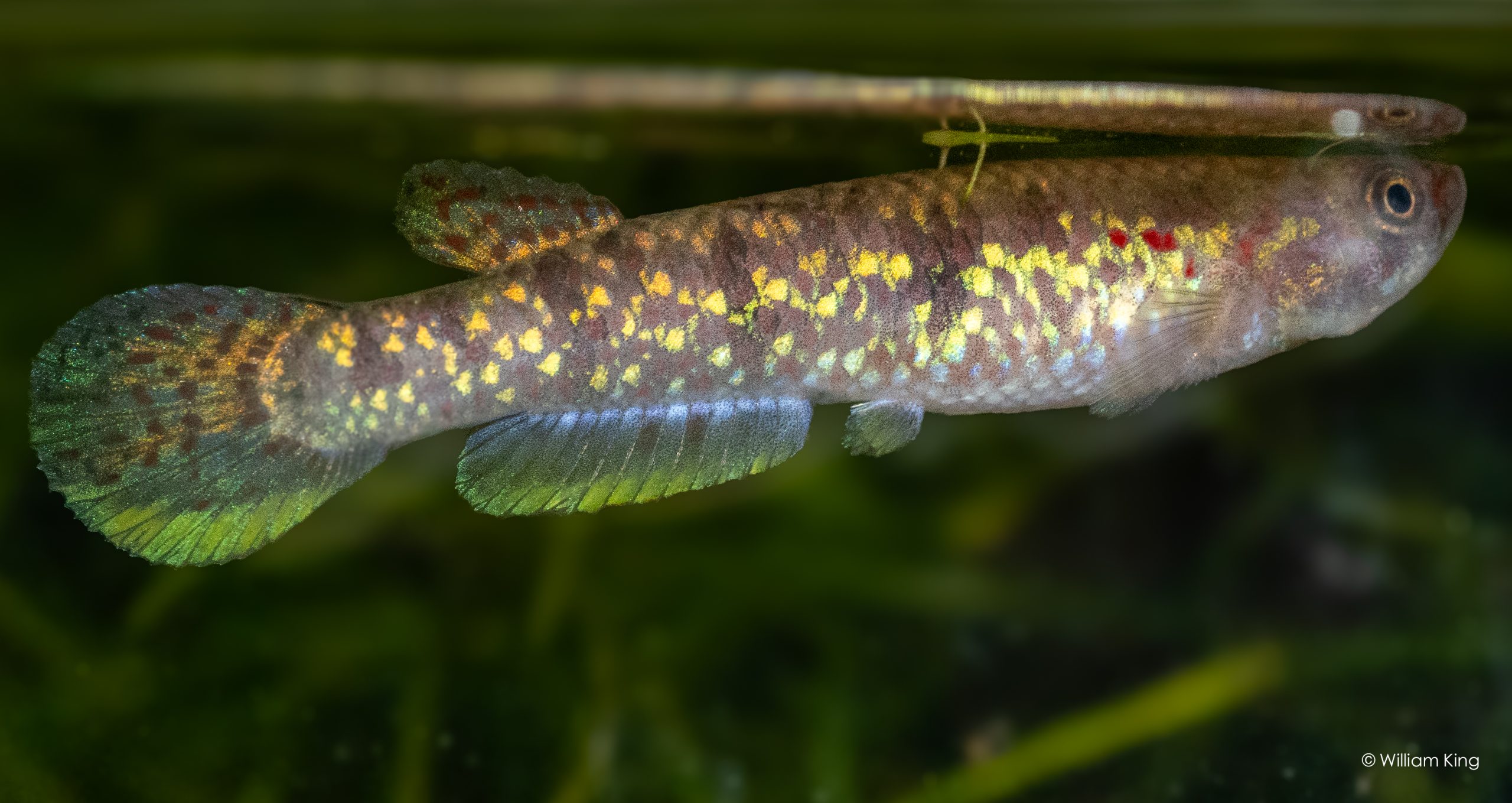
Description: The male is basically golden yellow. On the flanks are many irregular brown or maroon markings, which run together to form large blotches. They are especially pronounced on the back, becoming scarcer towards the belly and head. There are several electric blue spangles on the flanks. Immediately behind the operculum these markings may take the form of two or three parallel rows of dots which become less distinct farther back and finally merge with the other marks.
The caudal is very striking. The centre contains tiny dark red spots which run along the rays, radiating outwards like a fan. The top and bottom edges have a yellow, maroon or blue border. This border also appears on the anal, which is otherwise light blue with a few tiny dark markings. The dorsal is also blue with red spots and sometimes a light blue or yellow leading edge. The ventrals are colourless or brown, sometimes light blue or yellow. The pectorals are light brown, again edged blue or yellow. The whole body is rather slenderer than is usual with the genus.
The female is quite colourful. She is basically the same golden yellow as the male, with the same markings except that the irregular maroon markings are duller, browner, and the red spots are rather more numerous. Her fins are all reddish-brown, with perhaps some darker markings in the anal and caudal.
Breeding: Quite prolific when in the mood but this appears to be one of those species which spawns for a few weeks, laying 10-100 eggs weekly, and then rest for a month or two. Smallish eggs are laid at any level, but if sunken peat is provided the fish prefer this. The fry are, as would be expected, quite small, and do better if supplied with infusoria for the first few days. The fry are rather delicate; at least, some batches of fry seem to be. It is better to make any water changes very gradual. The eggs hatch in 12-18 days and do better if kept away from bright light. Quite often fry may be found swimming happily in the tank with the adults, and although no doubt most are eaten a few will grow to maturity there. Maturity is reached in four or five months.
Size: Usually, 2.5″ is the maximum size for the male, with the female slightly smaller, but there is a certain strain of the species kept in, among other places, Australia, which grows much larger, up to 3.5″. This is also a much heavier-bodied fish.
Maintenance: Not as robust as many species of the genus, this fish is rather shy and appreciates plenty of cover. It does well in the normal soft acid water used for killies and likes all small live foods. The mouth is not large; this means not only should smaller foods be given but also that it is quite safe to trust this species with smaller fish, which will not be eaten or bullied. Fighting is not common, and only takes the form of mild squabbling, with little or no harm done. A temperature of 64-75F. (18-24C.) is quite suitable, and spawning will occur anywhere in this range. If species are mixed, this fish should not be asked to share a tank with large robust species, as it will tend to hide away in a corner.
Conclusion: A very desirable fish which poses few problems to the average aquarist.
References: