Skip to content
British Killifish Association
  • Events
  • Join/Renew
    • Join/Renew
    • membermojo
  • Buy Killifish
    • Buy Killifish
    • Auction rules
  • W.Africa Killifish
    • W.Africa Killifish
    • Killifish
    • Nothobranchius A-Z
    • Eurasian Killifish
  • Killi-News
    • Killi-News
    • BKA Publications
    • Killi-News Archive search
  • Mick Agnew Fund
  • Species Maintenance
    • Species Maintenance
  • Killi-Data
    • Killi-Data
    • killi-data.org
  • Links
  • Learning
    • Beginners guide
    • Beginning with killies
    • BKA Guide to Killie Keeping
    • Chromaphyosemion History, Maintenance and Breeding
    • Nothobranchius Maintenance and Breeding
    • South American Annual Killifish Maintenance and Breeding
    • Cyprinodon (and Aphanius) Maintenance and Breeding
  • About
    • About
    • History
    • MC Agenda
  • Search Icon
Laimosemion frenatus

Laimosemion frenatus

LAIMOSEMION FRENATUS (Eigenmann, 1909)

Male Maburo road (photo: R.H.Wildekamp)
Female Maburo road (photo: R.H.Wildekamp)

Originally published as: “Rivulus frenatus” B.K.A. Information Pamphlet New Series No.3 October 1991

Sub-genus: none

Etymology: with a bridle; refers to the dark stripe on snout and operculum.

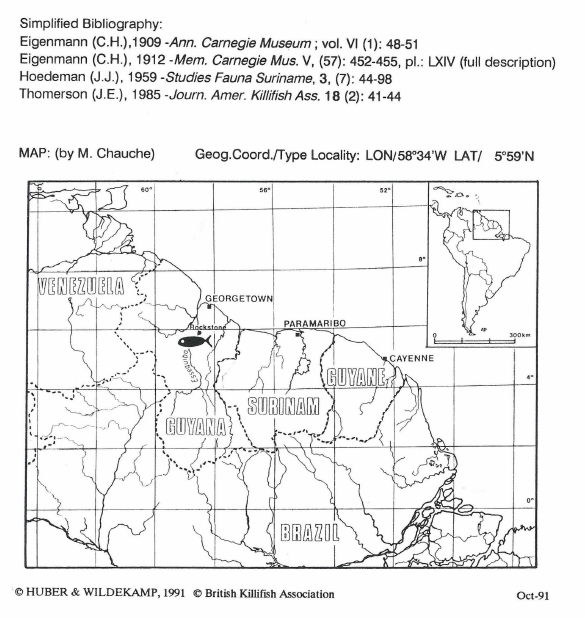
Type locality: Gluck Island, an island in the middle of the Essequibo River, near Rockstone, northern central British Guyana.

Synonymes: none

Related Species/group: Rivulus xiphidius and Rivulus campelloi

Scientific Key Datas: D=7; A=11; LL=40

Common name: none

Populations/aquarium: Maburo Road.

Remarks: the Surinam populations, identified as frenatus by Hoedeman (1959), belong to another species, probably agilae.

Biotope: dwells in rivulets and pools, with thick vegetation.

Distribution: only known from a few localities, near Rockstone, up to now.
Advised especially for: confirmed hobbyist

Maintenance and Breeding: seems rather easy, from preliminary experiences (the fish were brought back alive at the beginning of 1991 by Suyker and Vermeulen, 2 Dutch aquarists); incubation period: 2-3 weeks; growth is slow; sexual maturity reached at 8 months.

Max. size: Male 40mm. Female 35mm.

Life span: 36 months.

Login Status

Forgot? 

Articles

  • Tim Addis’s Killifish of West Africa
  • Killi-News Archive
  • History of the BKA
  • Eurasian killifish
  • Maintenance and breeding of Cyprinodons (and Aphanius)
  • Maintenance and breeding of Nothobranchius
  • Breeding & maintenance of S.American annual Killifish
  • BKA Guide to Killie Keeping
  • The Aphyosemion subgenus Chromaphyosemion
  • First observations on the reproduction in captivity of Profundulus adani KN 625 Mar/Apr 2025
  • Uganda ’88 – Ian Sainthouse KilliNews 281-285 1989
  • Aphyosemion wachtersi and Aphyosemion buytaerti by Christian Cauvet KilliNews 585 Jul/Aug 2018
  • Paludopanchax: Charming annuals from the Gulf of Guinea countries KN 588 2019
  • Brazil 2017 by J.W.Hoetmer KilliNews Issue 591 Jul/Aug 2019
  • Return to Leticia KN 594 2020
  • COCCA 2019 by Christian Cauvet KilliNews 596 May/Jun 2020
  • A killifish adrift in the Indian Ocean by Jérôme Blanc KilliNews 610 Sept/Oct 2022
  • BKA Video Library

Live Foods

  • Infusoria
  • Microworms
  • Vinegar Eel Culture
  • Baby Brine Shrimp
  • Moina
  • Grindal worms
  • White worms
  • Fruit flies

Techniques

  • Posting Killifish
  • Beginning with Killies
  • Equipment list

Gallery

  • All
  • Aphanius and Valencia
  • Aphyoplatys
  • Aphyosemion
  • Aplocheilus
  • Archiaphyosemion
  • Austrolebias group
  • Callopanchax
  • Campellolebias
  • Chromaphyosemion
  • Cyprinodon
  • Epiplatys
  • Fundulopanchax
  • Fundulus
  • Fundulosoma
  • Gnatholebias
  • Jordanella
  • Leptopanchax
  • Lucania
  • Maratecoara
  • Micropanchax
  • Neofundulus
  • Nimbapanchax
  • Nothobranchius
  • Scriptaphyosemion
  • Simpsonichthys group
  • Pachypanchax
  • Pitunia
  • Platypanchax
  • Plesiolebias
  • Procatopus
  • Pseudepiplatys
  • Pterolebias
  • Renova
  • Rivulus group
  • Terranotus
© 2026   Copyright. British Killifish Association All Rights Reserved.