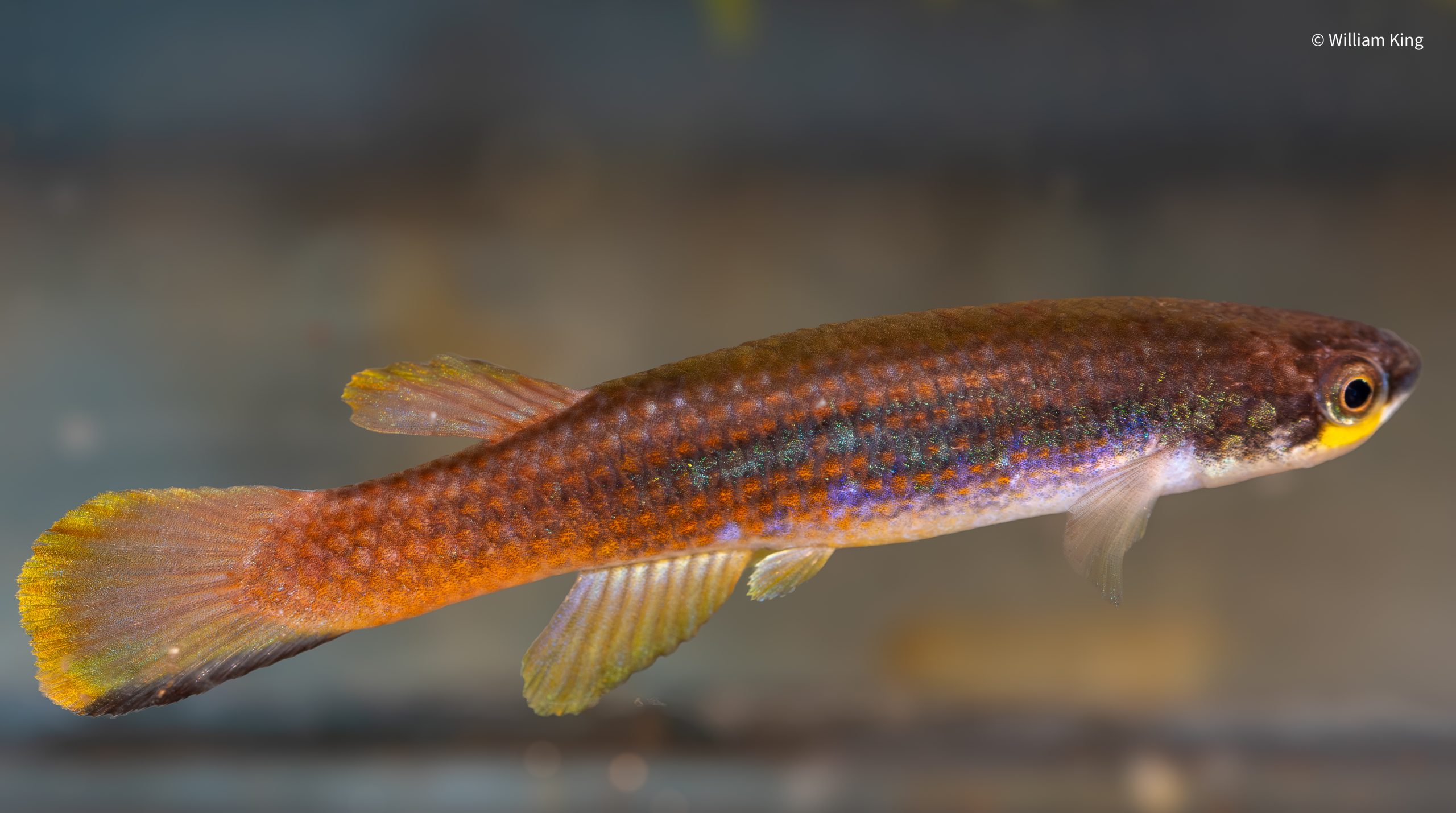
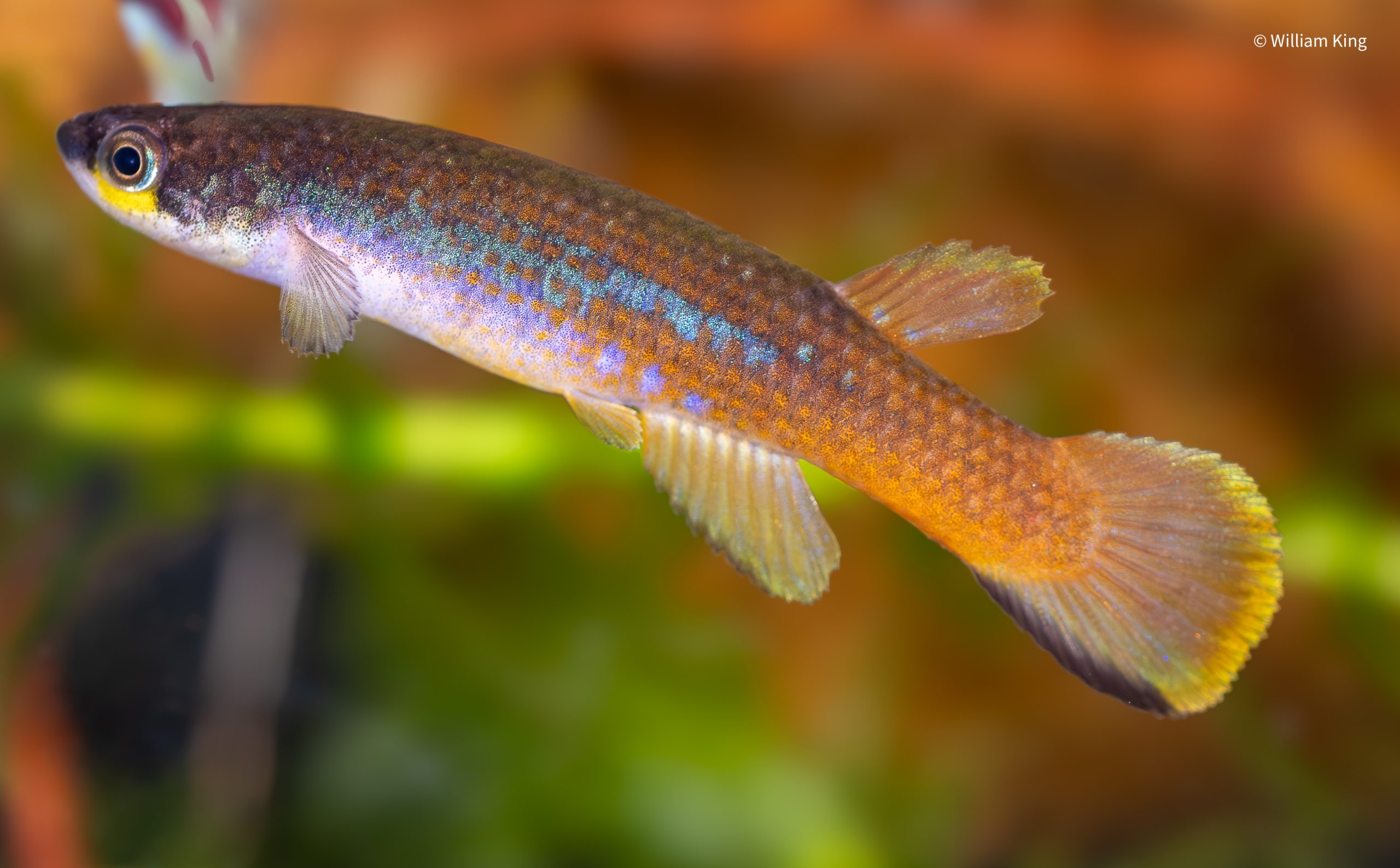
Laimosemion agilae
LAIMOSEMION AGILAE (Hoedemann 1954)
Originally published as: “Rivulus agilae” B.K.A. Information pamphlet No.26 July 1967
Habitat: This fish a species that inhabits small fast moving and rocky streams. It comes from Suriman, between Agila on the Surinam River, and Berlin on the Para River. It is a shy species and prefers temperatures between 70 and 82F.
Description: Male The body consists basically of earthy pastel shades of green and brown, with the underside being a fawn to yellow – white colour. Its flanks are of a pale bluish green colour with reddish – brown spots. The fins, with the exception of the caudal, are greenish with reddish – brown bands. The anal fin has a dark brown edge. The most striking feature of this species is the caudal fin which is two-toned. The upper half is pale green with a yellowish – white rear edge. The lower edge of the fin is dark brown. The fish is cylindrical in shape with its upper surface flattened as far back as the dorsal fin, this being set well back.
Female A little smaller than the male and not very colourful. The body is pale bluish – grey covered in a dark marbled pattern that extends into the caudal and anal fins. The most notable feature of the female is the anal fin which is a bright orange.
Size: Males grow to approximately two and a half inches with the females a shade smaller.
Feeding: Like the majority of Rivulus species they prefer a diet of live foods such as daphnia, white worm ect. but will also take dried foods.
Breeding: Small breeding tanks 12″ x 8″ x 8″ in size are quite suitable for this species. The spawning medium may be either nylon mops or fine leaved plants. The mops may be suspended from corks or lie weighted on the bottom of the aquarium, also the plants may be left to float or planted in small pots. Laimosemion agilae does not produce large numbers of eggs, with five a day being about the maximum. A spawning temperature of 74 to 78 F. seems to suit them best. Water conditions: DH 75-150 ppm. pH 6.8 to 7.2.
The incubation period is from ten to fourteen days. Newly hatched fry can be feed micro worm as a first food followed by brine shrimp after approximately a week to ten days. Progress to grindal and white worm as the fry grow in size. The eggs should be hatched in shallow containers having a depth of only three quarters of an inch of water, this depth being increased as the fry grow.
References: