Fundulosoma thierryi
FUNDULOSOMA THIERRYI (Ahl 1924)
Originally published as: B.K.A. Information Pamphlet No.66 January 1971
An attractive little fish from West Africa, this species has become quite well-known in the last two years due to importations of very many wild specimens during the D.Blair expeditions. It lives in small semi-permanent pools.
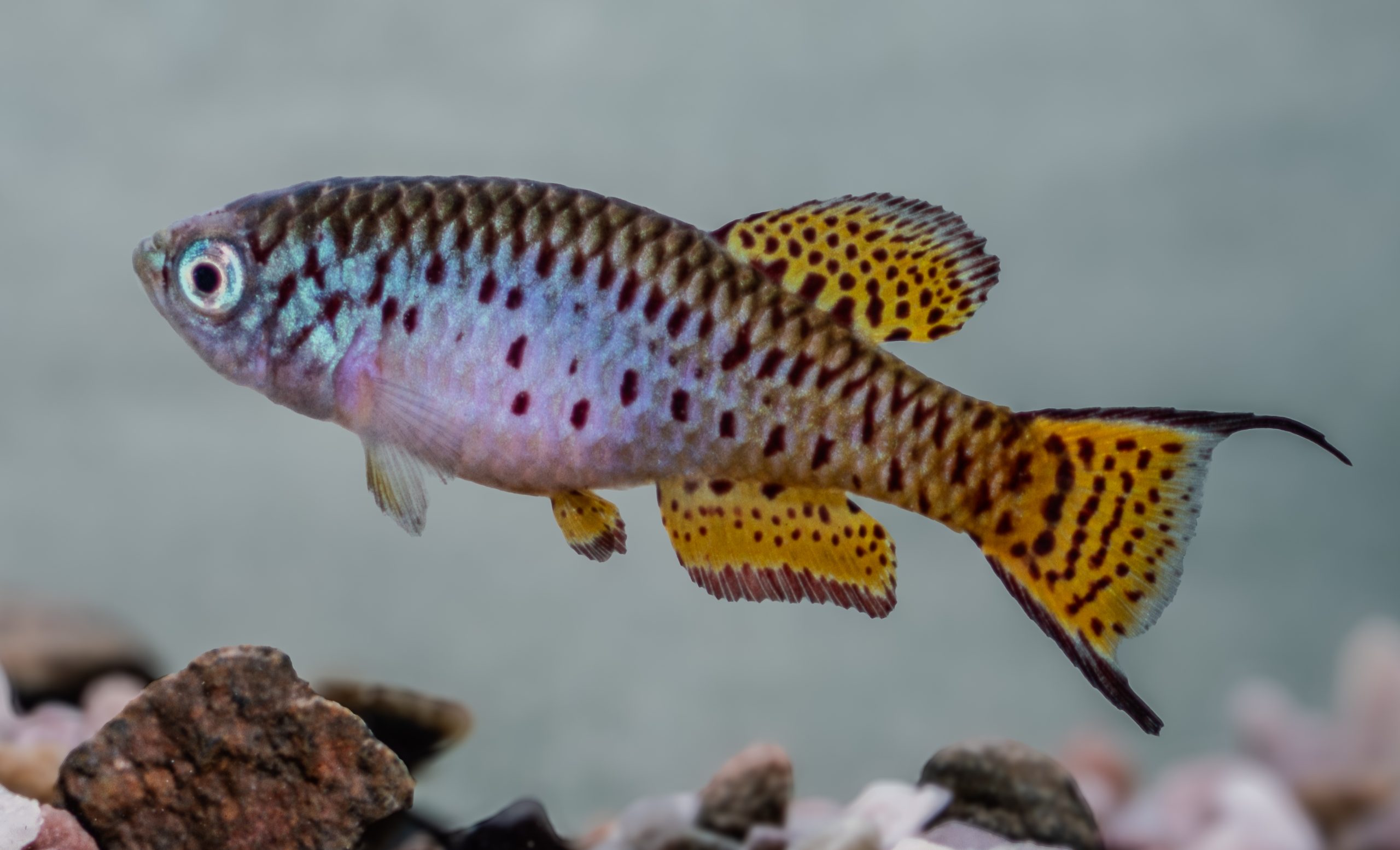
Description: The male, as is usual with killies, carries all the colour. A tiny fish rarely exceeding 1.25″ in length, he has a silvery blue body, marked, especially dorsally, with maroon spots. On the back these sometimes run together so that the back appears reddish-brown. The belly is paler.
The unpaired fins are yellow, with many maroon spots. They are usually bordered with a maroon bar. The dorsal and anal have a serrated outer edge, and in some strains the caudal develops very pronounced extensions, although in other strains these may be lacking or merely rudimentary. In the most colourful strains the pectorals are blue with a yellow outer border. The eye is blue and comparatively large.
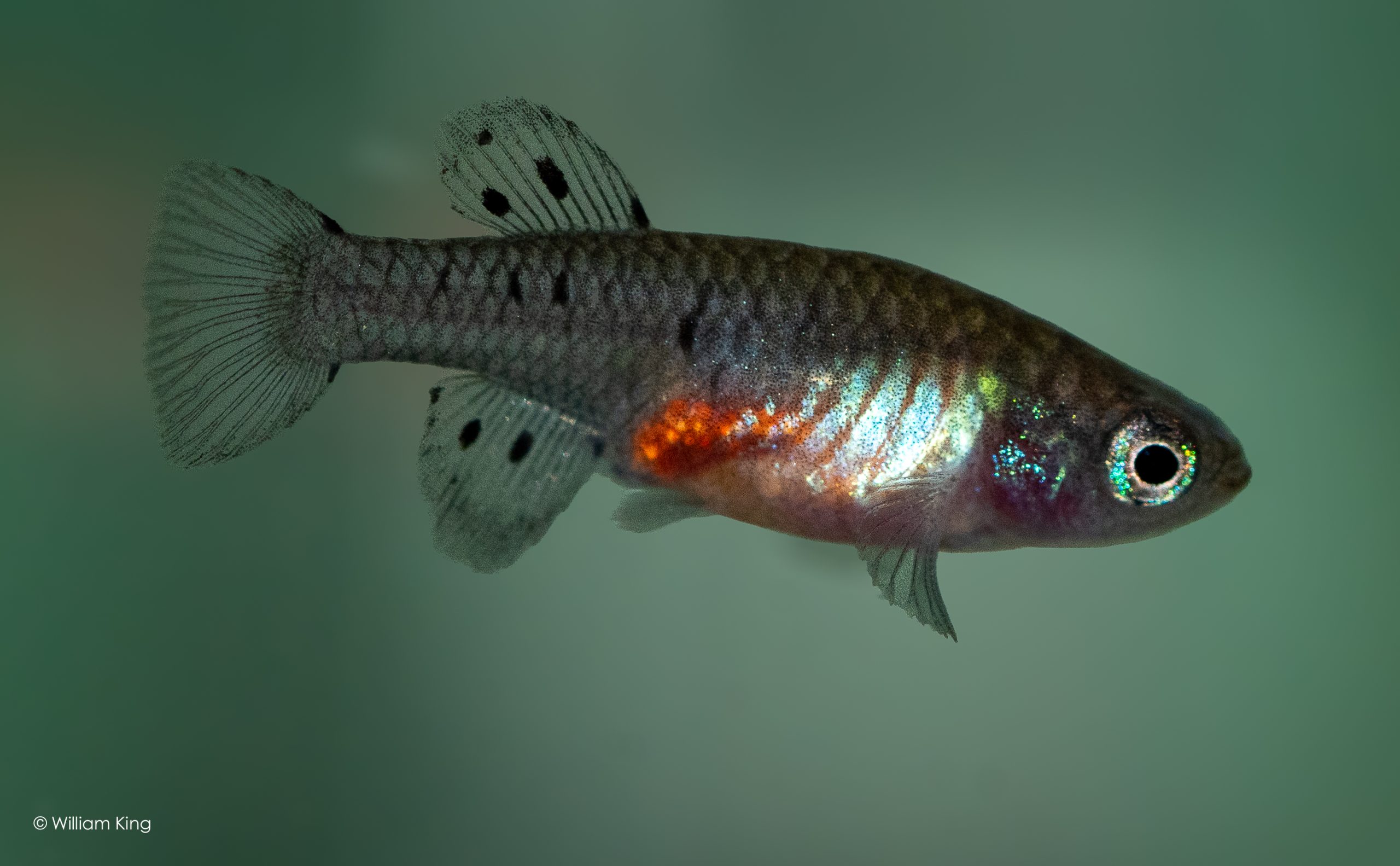
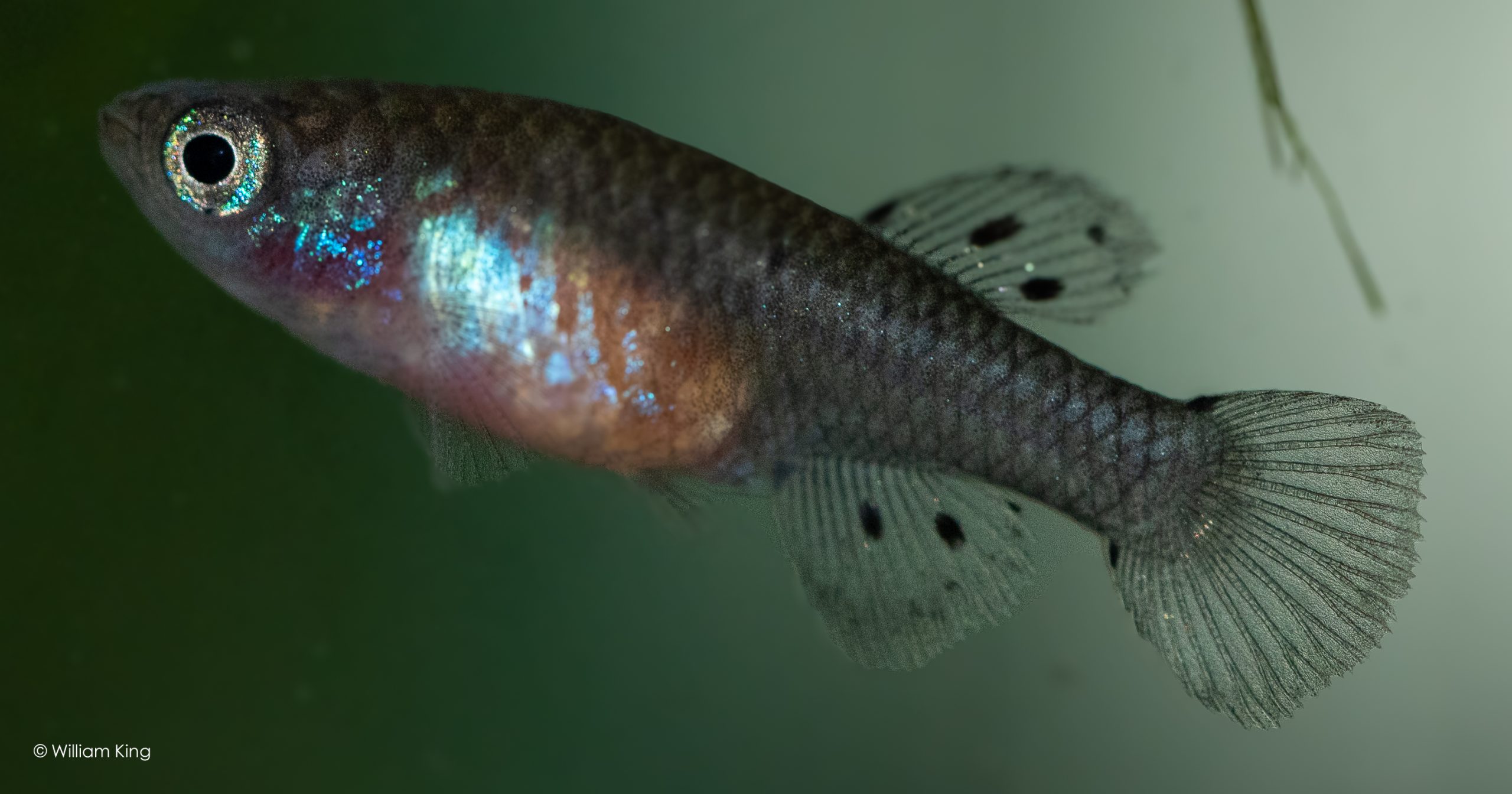
The female is usually even smaller than the male, and is a drab light brown, paler towards the belly. The unpaired fins carry a few tiny brownish spots. Really healthy females sometimes develop a pinkish tint over the whole body.
Maintenance: These fish are quite happy in soft, slightly acid water. They do not appear to like bright lighting, and being rather shy, need plants or lumps of sunken peat fibre for shelter. The mouth is small, and only the smaller live foods should be given. On more than one occasion I have lost specimens due to choking on accidentally introduced glassworm. Despite the small size, these fish are very pugnacious, and a watch should be kept for damaged specimens, which should be removed. This seems to be a short-lived species; ten months is the maximum I have kept the species in good condition, after which time they quickly show signs of senility.
Breeding: By no means a difficult species. It is one of the species I refer to as “Optional”, by which I mean that the eggs can be stored wet or dry. Eggs are laid singly in sunken peat or may be collected from a tray of fine sand. If the bottom of the tank is left bare eggs may be netted from the bottom glass every few days.
If the eggs are left in water, most will hatch erratically over a period of 6 to 25 weeks. The fry hatched by this method appear rather weaker than those hatched from dried eggs.
It is far preferable to store the eggs in well-squeezed peat for about 10 weeks. The fry are tiny delicate creatures which need infusoria for a few days. They are almost invisible except for the bright blue eyes. I am sure many hundreds of fry of this species have been overlooked and thrown away. Growth is quite rapid, especially in the early stages, and after three weeks, as secondary sexual characteristics begin to develop, fighting begins, and the more precocious of the young should be segregated.
An important point is that, just as males will attack and harm females which are unwilling to spawn, three or more females may attack and kill a male which is unable to give them the attention which they consider they deserve.
Conclusion: A very attractive and desirable species which by its colour more than makes up for the less pleasant side to its nature. It appears now to be firmly established in the BKA, and I thoroughly recommend it to those members who have not yet kept the species.
References:
http://www.killifishofwestafrica.co.uk/Ref_Library/Fundulosoma/Fundul.thierryi.htm
https://www.killi-data.org/mem221bersmysql/aa-header-services221.php?Rk_Hist=685%20rel=
https://www.killiclubdefrance.org/killi-fiches/358-fundulosoma-thierryi.html
Fundulosoma thierryi and it’s relatives Dr A.Radda (Killi News 97 Sep 73 p1-6)
Fundulosoma thierryi (Mali) – A.Pinto (Killi-News 224 April 1984 p119)
Fundulosoma thierryi E.Bowden (Killi-News 374 Nov p159)
Geography of West Africa Part 3 (Senegal and Gambia) (Epiplatys bifasciatus, Epi. spilargyreus, Scriptaphyosemion geryi, Scrip. Guignardi, Fundulosoma thierryi, Micropanchax normani, Pronothobranchius kiyawensis, Aplocheilichthys spilauchen) – M. Wessels (Killi-News 378 Mar 1997 p36-39)
Fundulosoma thierryi GHN 06, Location 2 Peter Riley (Killi-News 503 Aug 2007 p99)