Fundulopanchax puerzli
FUNDULOPANCHAX PUERZLI (Radda & Scheel 1974)

B.K.A. Information Pamphlet No.103 May 1976
Biotope: A small tributary stream of the Wuri River, Cameroons. Water conditions, hardness 1 degree German, pH 6.4, temperature 25.8C.
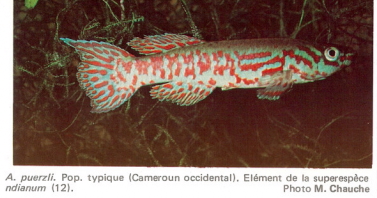
Fundulopanchax puerzli is a very recent introduction to the aquarium hobby and has, because of its striking colouration, proven a most popular species, in colouration it rather resembles that of Aphyosemion louessense Pellegrin 1931, which inhabits small streams in the Brazzaville area of Zaire. Basically, the flanks colouration of F.puerzli is of a greenish – blue, dorsally olive and the belly region of pale green to white. Overlaid along the flanks are vertical, slightly oblique, splashes of vermillion red. The eye is bold and has a vermillion streak from the edge which extends to the gill covers. Other red markings are present around the gill covers. All fins are basically of a pale green hue, the unpaired fins having a series of large red spots some of which merge to form stripes in the direction of the fin rays, particularly in the caudal fin. The dorsal and caudal have an inner red margin and a final outer margin of bluish – white. The caudal is slightly trilobite with the upper edge extended to form a filament which takes on a dark red or black colouration.
Maintenance and breeding: A species which does not appear too difficult to keep in the aquarium, seemingly to be happy in a variety of water conditions. A dimly illuminated tank having water of 24C. and conditions of hardness between 2 and 5 degrees German with a pH of 6.8, seems to suit well for general maintenance and for breeding attempts. Feeding presents few problems as all usual types of live foods are accepted and greedily eaten, some dry commercial foods are also accepted.
For breeding a suitable sized tank of 3 to 5 gallons should be provided and furnished with either peat moss, peat fibres or sphagnum moss. F.puerzli is very much a bottom spawning species and appears to revel in a large area of bottom space in order to chase and to lay eggs. Eggs are laid frequently and may be left with the parent fish for two weeks before removal for either water incubation or drying as with the more annual Killie forms. Eggs which are water incubated, take some 30 to 32 days to hatch at a temperature of 22C. Eggs which are dry stored should be incubated for seven to eight weeks at 22C. Although the water incubation method can give results it would seem that fry are much stronger if dry incubated as outlined. The fry are of medium size when newly hatched and able to consume fine Artemia and, within a few days, small or grated Grindal worm. Growth is rapid and would suggest that F.puerzli is, in the wild, an annual form.
Summary: This very striking and obliging species in regard to degree of ease of handling in the aquarium, grows to some 2.75 to 3 inches in captivity and in its adult size is a breathtaking spectacle. The females also have a charm and quite beautiful colour pattern and are unlike other females of the Fundulopanchax genus. In the wild this species is sympatric with Fundulopanchax riggenbachi Ahl 1924 and Epiplatys sexfasciatus Gill 1862.
