Fundulopanchax mirabile traudeae
FUNDULOPANCHAX MIRABILE TRAUDEAE
B.K.A. Information Pamphlet No.85 August 1972
Biotope: West Cameroons. Specimens were obtained from the Cross River System close to mile 54 on the Mamfe road and taken from the Banga River near to Manyemen. Specimens were also obtained near to the first place of capture, between Manyemen and Ngouti. At the time streams were in spate and the fish were found sheltering close to the banks. Water turbulent and brownish, no pH or DH available.
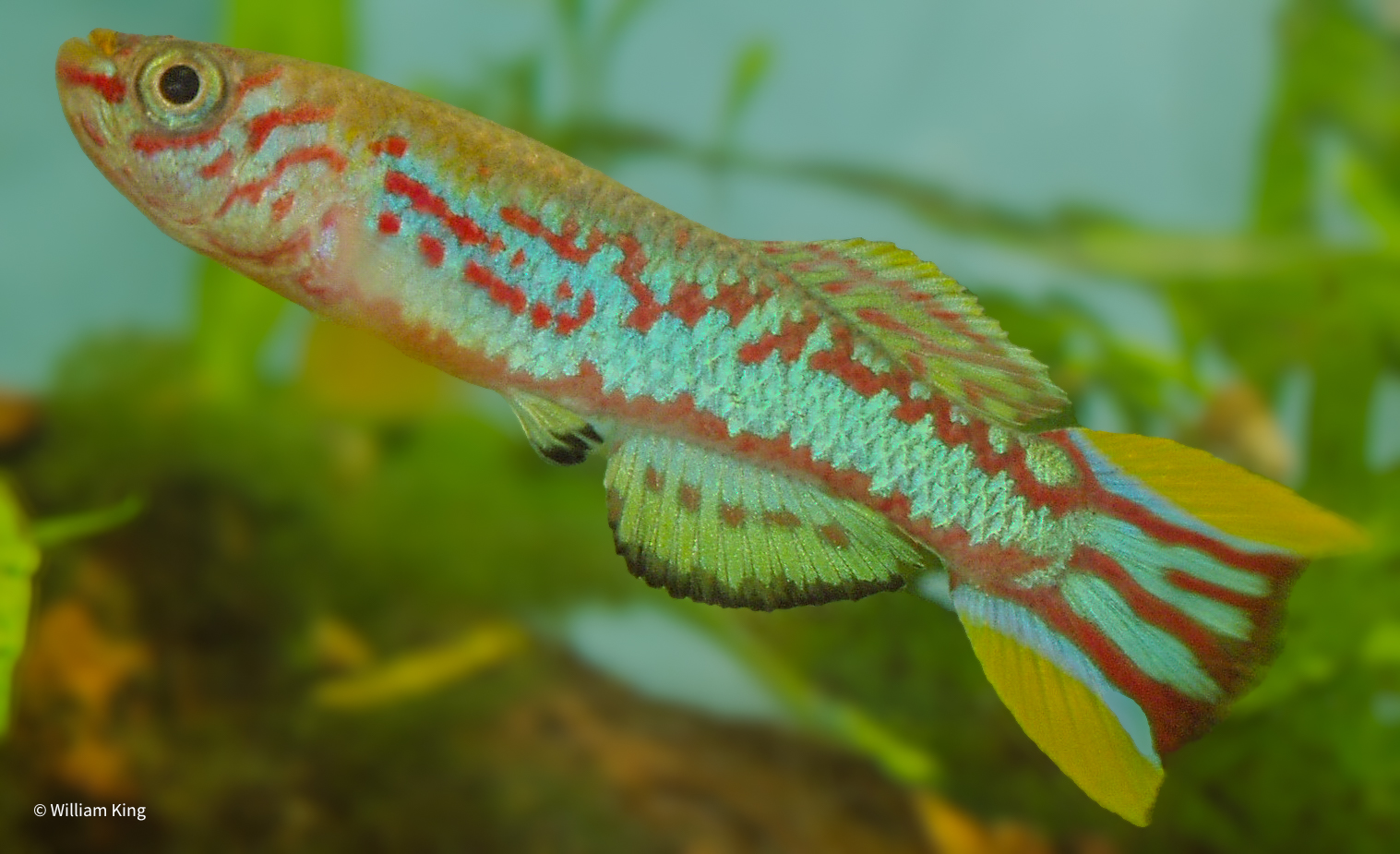
Description of the male: Dorsally olive green. Head large and eye bold with green iris, mouth upturned as is general for the genus. Red spots and streaks about the head. From the head, for the first third of the flanks the colour is of a dusky pink as is the belly region through to the caudal peduncle. Over the entire body are spots of crimson of varying sizes, some joining to form almost perfect squares of this colour. The basic colour of the remaining two thirds of the flanks is of an intense emerald green. All fins are large and well carried. The dorsal fin is placed well towards the caudal and is olive to grass green in colouration and having a thin margin of a very deep red which appears as black. The caudal is flamed, the centre of which is green with many dark markings and some fine red spotting which gives a lace like appearance to the fin. Two thirds of the upper and lower margins are of a greenish yellow hue. It is stated that in some specimens from the wild, filaments are carried top and bottom of the caudal but so far this has not been observed in aquarium raised stock. The anal fin is olive at the root and grass green for the major portion of the fin with an outer margin of dark red which appears as black. Pelvics, light green with a small black tip. Ventrals, amber to orange.
Size of males: Said to reach some 3″ plus in the wild but aquarium raised fish attaining only 2.5 to 2.75 inches.
Description of the female: Once again we note the sombre colouration of this sex which is more or less general for the whole of the genus Fundulopanchax. The female of this sub-species being of a middle shade of brown to light tan and without and distinguishing markings. Fins are very pale brown to transparent. Size attained about 2.5″.
Maintenance and breeding: Rather an easily kept species given conditions which are not difficult to achieve. Clean water is appreciated which should be in the region of from 6.5 to 7.0 pH and with a DH of from 4 to 7 German. Fairly low temperatures are all that is required for normal maintenance, 68 to 70F. suiting. Plant life in the aquarium is a benefit mainly as a refuge for the female when driven hard. Peat fibre sub-strate should be in about a two-inch layer, this will provide places of safety for any fry which may hatch in the spawning tank. Not over fussy in regard to food and will accept all normal live foods and also dry flake foods, beef heart and cod’s roe. With good feeding and a slightly higher water temperature, 74F. the fish will commence to spawn using both sunken and floating mops on which to deposit eggs. Most eggs are layed on submerged plants or mops and are longer in hatching than those laid on surface plants or mops. For the submerged egg hatching time is from 25 to 40 days and from 18 to 22 days for eggs taken from floating mops. Some eggs will be found to be in diapause state and are very difficult to induce to hatch even although the embryo is perfectly formed and alive. By far the best results have been from allowing the fry to hatch out in the spawning tank and grow on with the parent fish, very few seem to be eaten and the rate of growth is speeded up using this method. Fry are large on hatching and well able to consume all the·normal fry foods. It has been noticed that brine shrimp will not be sought out after the third week of life. At about the 1″ stage sexing occurs and growth will slow down, fish are not fully adult until about 10 to 12 months old although sexually mature before this time.
History: A species first introduced in the BKA after the David Blair expedition to West Africa in 1970. First reported by Col. J.J.Scheel and given the common name of “Mountain Aphyosemion“. It was also collected by Dr. A.Radda of Vienna and consequently named by him as a sub-species of Fundulopanchax mirabile. The wild stock received into the BKA was subsequently propagated by members and distributed in many overseas countries.
Summary: A very beautiful and rewarding species, one which is easily cared for but not too easily bred. Eggs in the diapause state creating something of a problem at this time. Must become a firm and established favourite. Has some likeness to A.gardneri Boulenger +1911, a species to which A.m.traudeae is related.
References:
http://www.killifishofwestafrica.co.uk/Ref_Library/Fundulopanchax/Fp.mir.traudeae.htm
https://www.killi-data.org/mem221bersmysql/aa-header-services221.php?Rk_Hist=1212%20rel=