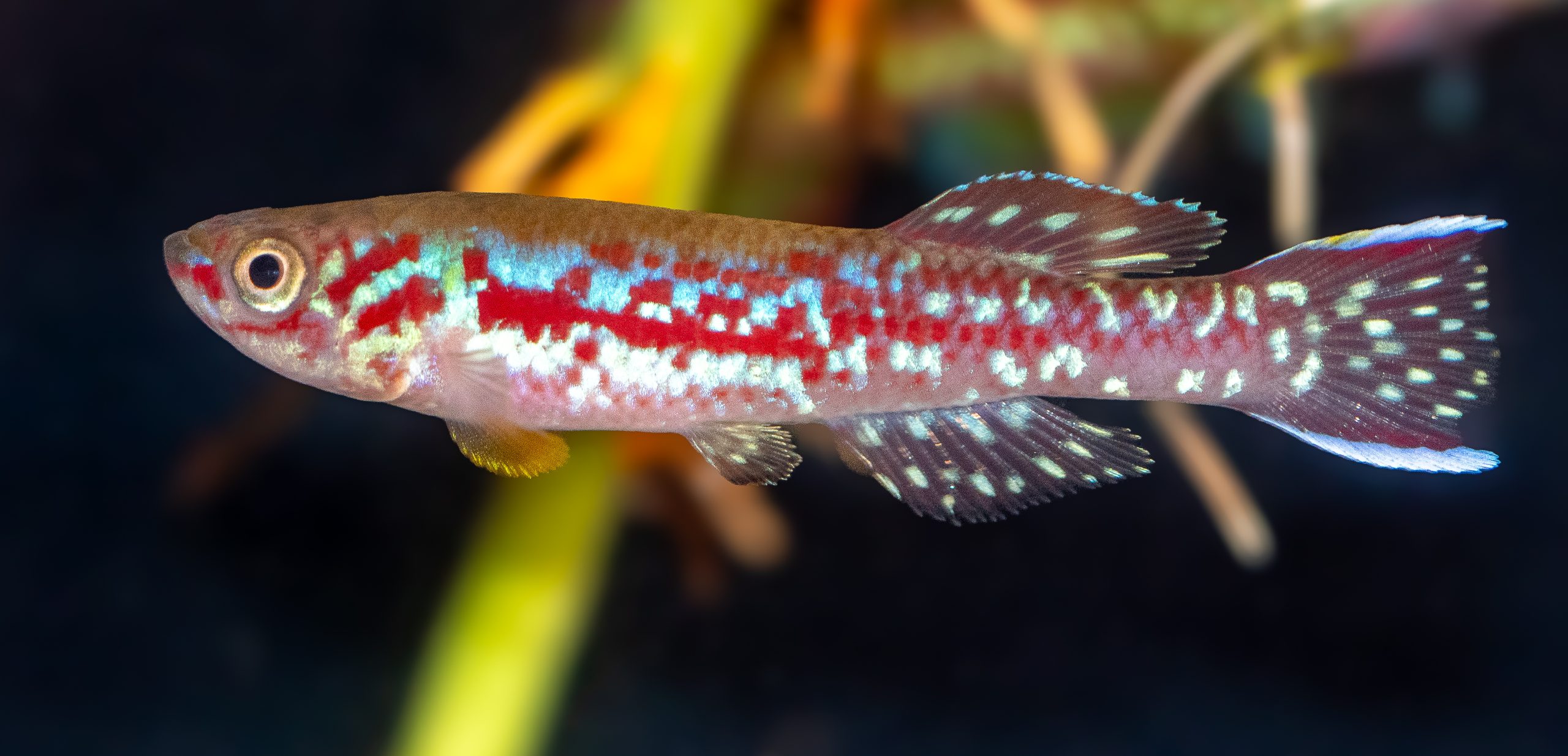
Fundulopanchax mirabile mirabile
FUNDULOPANCHAX MIRABILE MIRABILE (Radda 1971)
Originally published as: B.K.A. Information Pamphlet No. 96 September 1974
Biotope: Brook near to Mbio and in a brook in a rain forest between Fainchang and Mbio, West Cameroons. pH of water 5.6, DH 1 degree German. Water temperature 24C. (approx 75F.)
Description of the male: Dorsally olive to olive green. Eye bold with golden iris. Head ice blue beneath eye. Top of head olive upon which are a few dark streaks. Two vermiform marks present upon the operculum of crimson, becoming more numerous towards the caudal peduncle. Dorsal fin purple in the first two thirds with an outer margin of light blue to white, several spots of blue present in the darker portion. Caudal purple upon which is some spotting of blue with a dark inner margin, top and bottom, of deep crimson and a final outer margin of white to blue-white. The anal fin at the root is of ice blue, the remainder of the fin being purple upon which is some spotting of white to blue-white. Pelvics purple, tipped blue-white. Pectorals light orange to transparent.
Size attained in the aquarium: About 2.5 inches.
Description of the female: Very much like other females of the F.mirabile group of fishes and females of the F.gardneri complex. Basically olive to brownish olive, fins transparent or slightly suffused pale brown in some specimens. Eye bold, iris golden.
Size attained in the aquarium: About 1.75 inches.
Maintenance and breeding: If given adequate cover and a darkish covering to the tank bottom this species will show its full striking coloration. Not fussy in its water requirements and may be kept in health in water of: pH 6.8, DH 2 to 4 degrees German with a temperature in the region of 22C. Pairs may be kept in small aquaria of about 2.5 gallons capacity but frequent water changes are essential. Feeding entails no difficulty as F. mirabile mirabile will accept most types of fish foods, including prepared dried foods of good quality. However, for conditioning live foods are to be preferred. Any type of live food is greedily taken.
Breeding the species is not difficult and F.mirabile mirabile seems +to be one of those species without any seasonal fluctuation in egg production. Small aquaria are prepared with a bottom layer of peat fibres, water conditions as for the stock tank, a slight rise in temperature to 24C. will help. The tank should not be exposed to too much light. Depending on the size of the spawning pair, a number of eggs will be laid each day, in and upon the peat fibres. After about a week’s spawning activity the peat containing the eggs should be removed, wrapped in several layers of clean newsprint, and allowed to dry to a just moist condition. The peat and the eggs may now be placed in sealed boxes or plastic bags, labelled with a date of storing and expected hatching date. Usually, a fair number of fry will emerge after thirty days of dry incubation when the peat and eggs are immersed in water at a temperature of 22C. Quite a number of eggs may, however, remain in the diapause condition, these may be left in water to incubate, which may take a further eight weeks. At times fry will appear in the spawning tank but stand little chance of survival unless masses of surface and bottom cover are available.
The fry are large upon hatching and are able to consume the normal first fry foods such as Artemia and, after a few days, micro worms. Growth is rapid providing that water changes are frequently given, Fry are prone to fighting and should be split up into small groups as soon as they are about 1/2 to 3/4 inch long.
Summary: Possibly the most beautiful form of the group, which includes, F.mirabile mirabile, F.mirabile moense, F.mirabile traudeae and a type, F.mirabile trudeae intermittens. A species which delights the heart of the true Killie fancier.
References:
http://www.killifishofwestafrica.co.uk/Ref_Library/Fundulopanchax/Fp.mir.mirabilis.htm