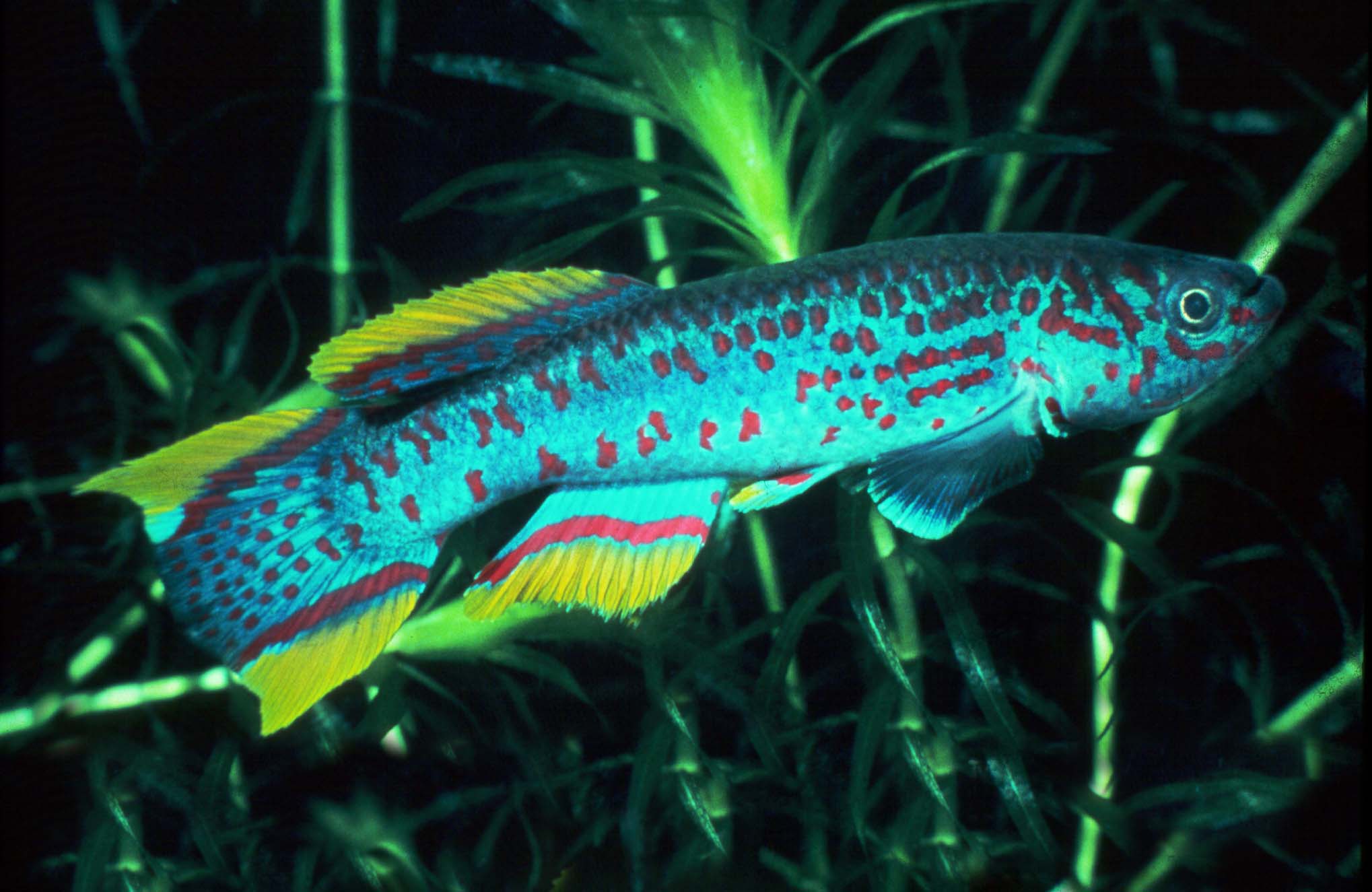
Fundulopanchax gardneri
FUNDULOPANCHAX GARDNERI (Boulenger 1911)
B.K.A. Information Pamphlet No.75 November 1971
Biotope: F.gardneri has a wide distribution throughout Nigeria and Western Cameroons, inhabiting regions of dense forest to Savannah where pools may be of a temporary nature. Water conditions extremely variable but usually having high organic nutrients.
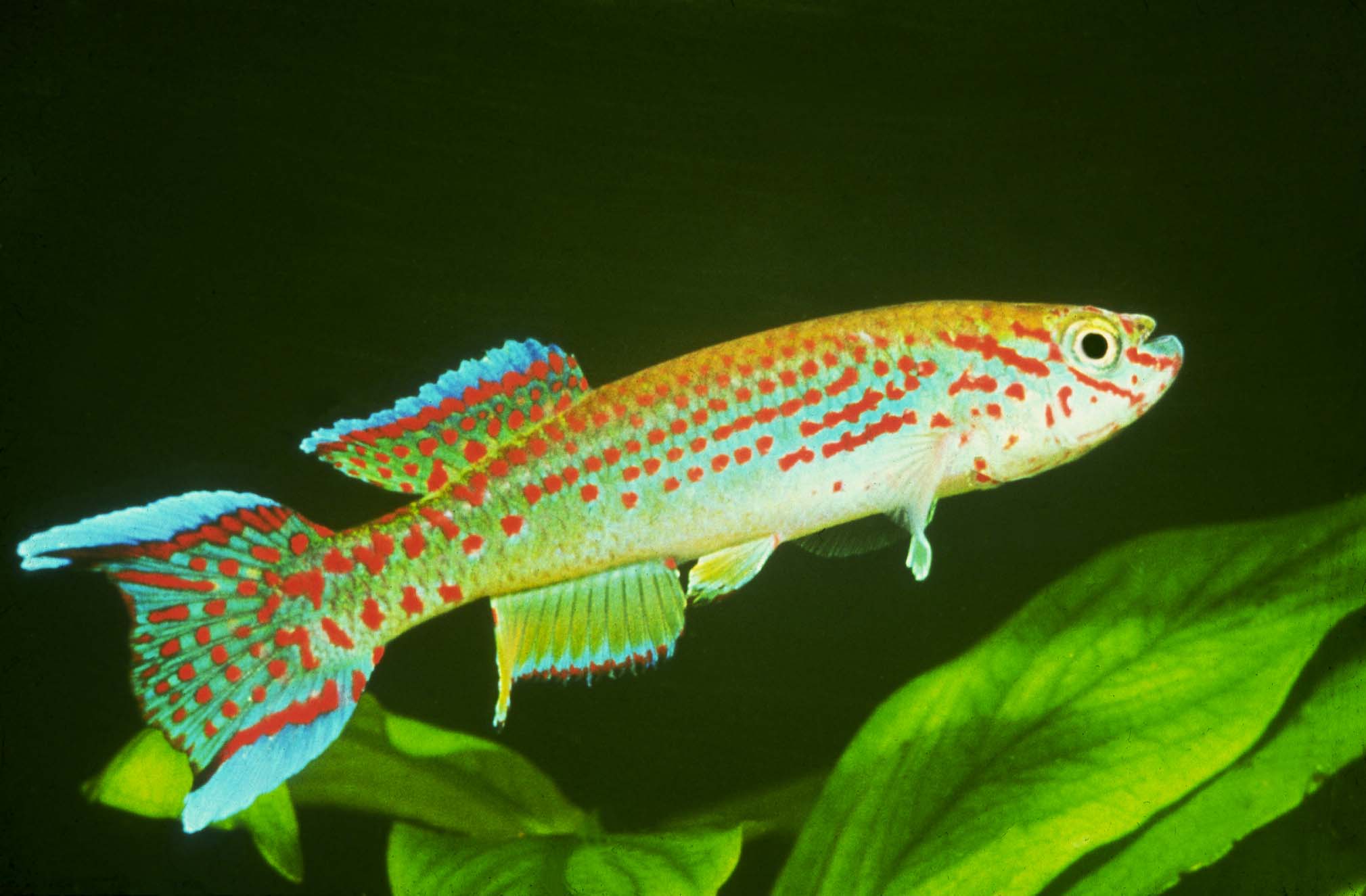
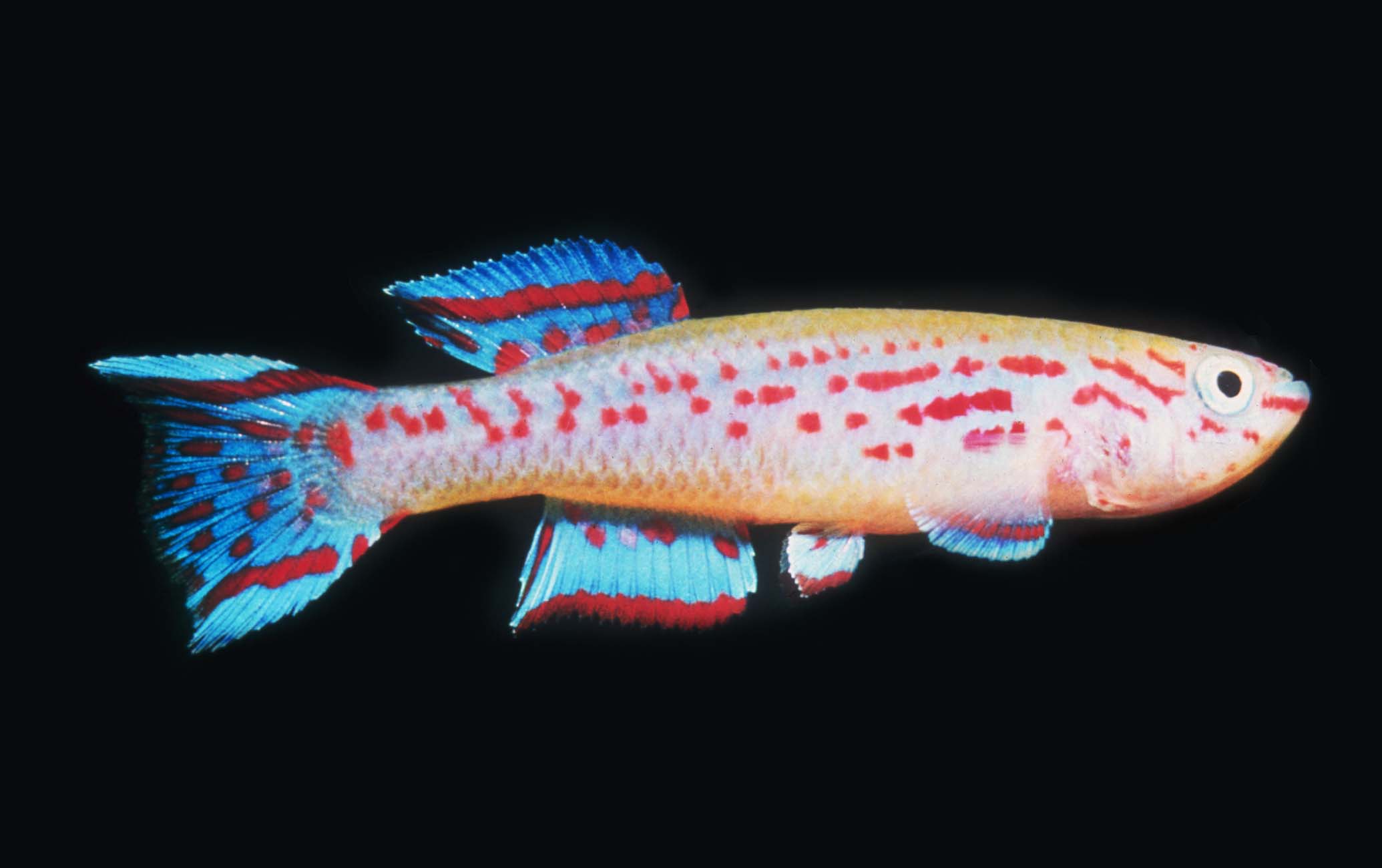
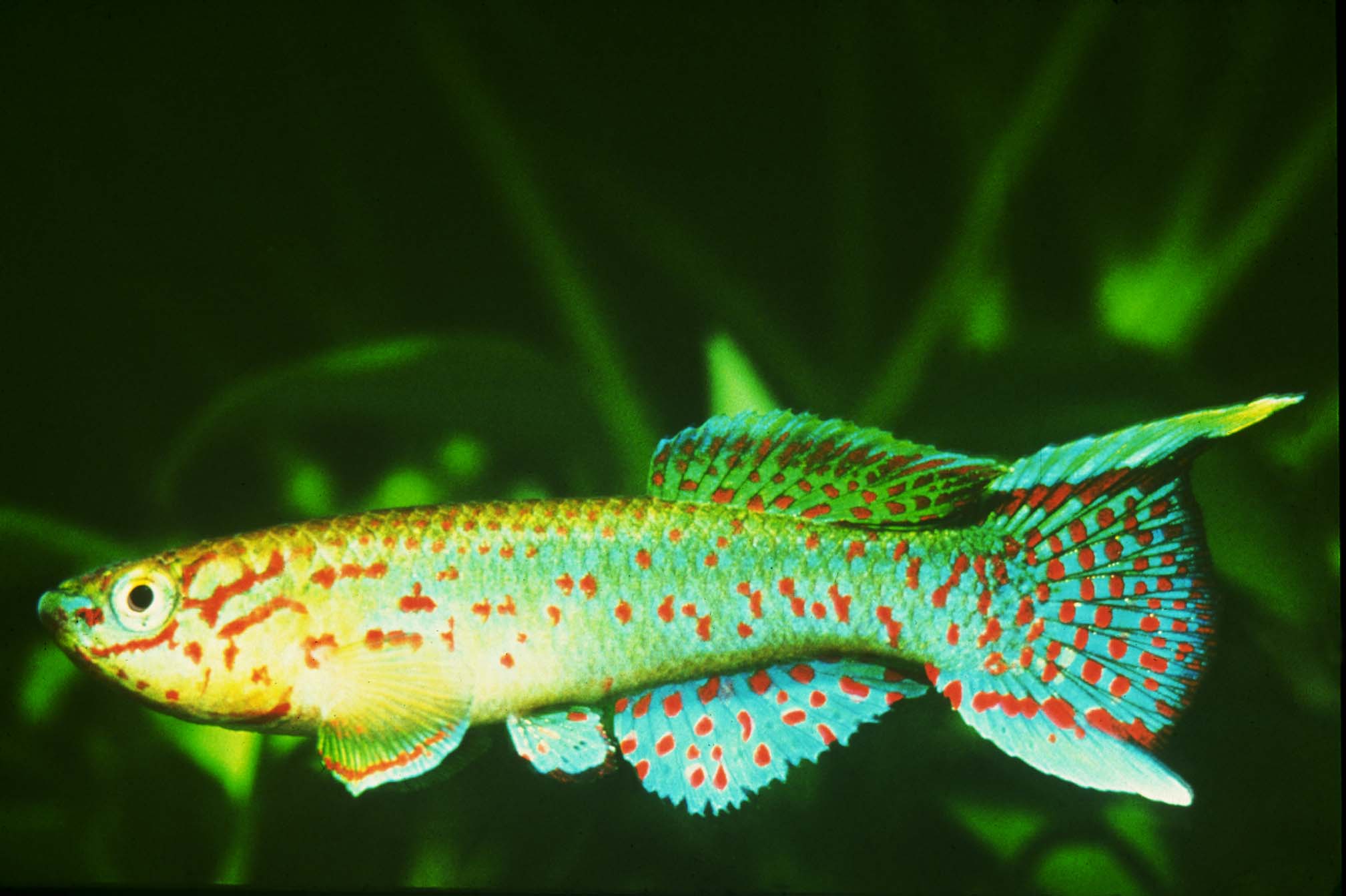
Description of male: It would be impossible in this comparatively short IP to give a description of all the populations of this species. There are many, it would seem, populations of F.gardneri each having its own distinctive colour pattern. A number of these populations are so different in colour that if it were not for shape and behaviour pattern the general aquarist would be forgiven in assuming them to be quite different species. What follows here is the normal aquarium F.gardneri of the yellow phenotype. It should be pointed out that there are several different populations of the yellow variety.
The basic body colouration is blue/green upon which is many spots and blotches of red or crimson. Dorsally the fish is of an olive to brown. The head is large and the eye bold, several worm like (vermiform) markings are carried around the gill plates, the lips are red. Dorsal fin well formed, blue to blue green at the root followed by a carmine to red edge with an outer margin of yellow to intense yellow, depending on origin of stock. Caudal fin centre blue/green and many carry several spots of red bordered by red to crimson with a final outer margin of yellow. Filaments to the caudal may develop in some specimens. Anal green to blue with red margin and outer border of yellow. Pelvics yellow with black or, in some specimens red outer border. Pectorals pale blue.
The size attained for aquarium specimens is usually in the 2.75″ region but specimens from the wild and at times in the aquarium can and do reach something over 3 inches.
Description of the female: Rather better proportioned than the male but lacking any brilliant colouration, being of a rather drab olive with some minute fly specking of a rusty colour. The females of all populations seem to vary very slightly and except for size are almost indistinguishable. Care should be taken to keep the females of the various populations separate at all times.
Size attained for the yellow phenotype is about 2.25″.
Maintenance and breeding: Perhaps one of the easiest of the Fundulopanchax genus to keep and breed although at times one may experience some difficulty in inducing stock to breed. It has been said that F.gardneri is the guppy of the Killie family. Most types of water seem to suit from moderately hard to very soft, although in hard waters colouration is not at its best. Perhaps water with a pH of about 6.8 to 7.0 suits best with a DH of about 7 German. Temperature for general maintenance and for breeding should be cool, 70 to 72F suiting well. Well fed stock are quite prolific under these conditions. Eggs may be collected every other day from floating or submerged mops. F.gardneri is not fussy as to spawning sites so both types of mop should be used. Eggs are large and almost clear, easily found in mops or peat fibre, if used as a spawning medium. Hatching occurs in from 11 to 14 days, few eggs are laid of the resting type. One may also leave the eggs to hatch in the breeding tank along with the adults, given plenty of surface cover a goodly number of fry will ·escape being eaten by the parent fish. It is a well known fact that fry left with the parents in the breeding tank grow at a much faster rate than those raised by the egg collection method, this applies to F.gardneri. With good feeding, which may consist of any type of live food plus a good brand of dry food, growth will be fairly rapid and sexing may be done at a very early stage in the fry growth. One should not let the very young fish of this species spawn, it is best to wait till the young fish are well grown before being allowed to spawn. Young males may be kept together providing that there are more than, say, three males in the tank. A goodly number may be kept together without any fear of damage through fighting. It would seem that the males are so busy watching each other that they have little time to mount an attack on any one chosen enemy.
Recently experiments have been done in which the eggs are dry stored as for the Nothobranchius species. Up until this time the maximum time for this type of storage has been for 45 days and which gave an eighty seven percent hatch. In view of the ease of breeding this species I cannot see the reason for dry storage except as a matter of interest.
Summary: A species which has suffered many name changes and quite a few invalid names, usually attached by importers or dealers. Once distributed as Aphyosemion calliurum ahli and Aphyosemion calliurum calliurum. Given the scientific name of Aphyosemion nigerianum (Clausen) 1963, later corrected to the original name as given by Boulenger. A very beautiful species when seen at its best. Suffers much from over in-breeding where size and colouration is lost. Has suffered a decline due to ease of propagation, which is a great pity. Truly a beginner’s fish and a delight for the true Killie keeper.
FUNDULOPANCHAX GARDNERI (CAMEROON)
Originally published as: B.K.A. Information Pamphlet No. 100 February 1976
Habitat: Cross River system, border area between Nigeria and Cameroons, inhabiting small streams and rivulets. Maybe related to the F.mirabile complex.
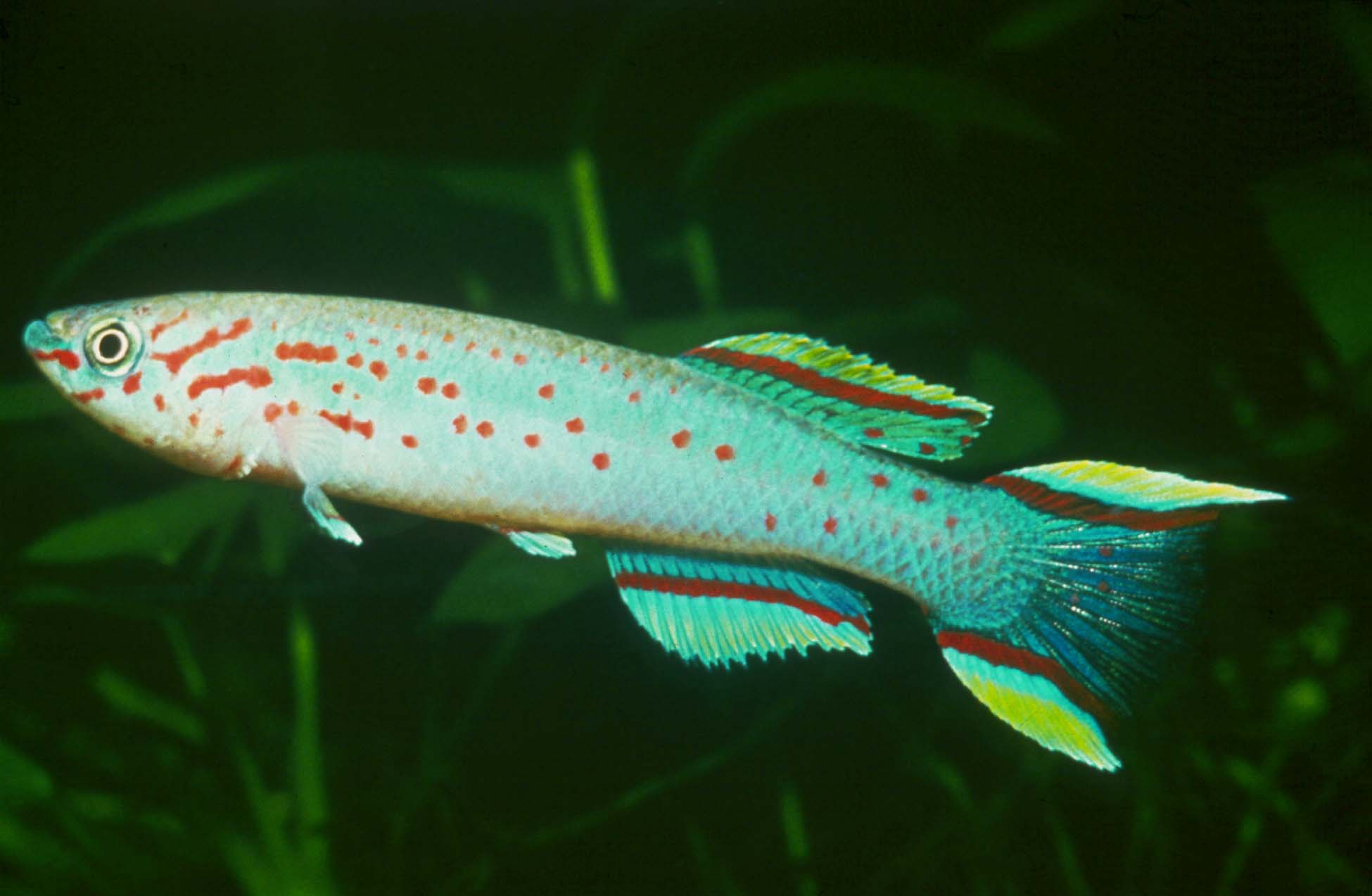
Description of the male: (Blue Phenotype) Flanks light blue upon which are small spots of red in longitudinal rows, these spots may be of unequal spacing. The rows extend from just behind the operculum and become irregular towards the caudal peduncle. The dorsal parts are of light green, from the head to the insertion of the dorsal fin. The belly is white with a pinkish sheen near the anal fin. Several vermiform markings are present on and around the operculum (wound markings). The dorsal fin is pale green and has some fly specking of rust colour, there appears no marginal border on most samples but in some there may occur a weak outline of some dark pigment. The anal fin is without any border but it has, on a light green background, spots and irregular markings in red. The caudal is basically light green to pale blue and has an outer margin of very light blue to white and a final margin of very dark red, no filaments present. In general appearance the male resembles the F.mirabile complex and may well be related to these fish. The ventral fins are pale blue to transparent and may, in some samples, have a black edging. Pevlics are transparent with a slight colouration at the root of pale blue. Size in the aquarium to about 2.5″.
Description of the female: Resembling many forms of the female F.gardneri complex being light olive, some samples may have few dark spots along the flanks. All fins transparent although females possessing dark caudal fins have been noticed. Size to about 2.25″ for aquarium raised stock.
Feeding: Adult fish take all live foods and a small quantity of high-grade dried food to supplement.
Maintenance: These fish are not difficult to maintain. They do well at a temperature of 70-72F. Water hardness fluctuates, and the fish show no ill effects. The degree of hardness varies from 1 to 5 degrees DH. pH 6.0 to 6.4. The reason for the fluctuation is that it has been found beneficial to keep the fish on gravel. Although this hardens the water the hardness is quickly reduced every time the water is changed, half the water being replaced with water of less than one degree hardness.
Breeding: Fish will spawn at seven months old but better results are achieved with more mature fish, preferably about ten months old. Eggs are medium size, colourless and round and are deposited both in green nylon mops and in peat fibres. The eggs removed are placed in clean, fresh water fractionally less than 1 degree DH and pH 6.0. The water is coloured very pale green the container is then covered lightly with a lid to keep out the light but not to exclude the air. The eggs are stored at a temperature of 74F. and hatching takes place after 22 days. Apparently, difficulty has been found in inducing the eggs to hatch but if the eggs have not hatched after 30 days, the water level is raised to exclude almost all the air and the lid replaced tightly. The increased carbon dioxide in the container usually results in a complete hatch of all eggs within three hours. The inspection of the eggs should be made hourly, and any fry removed otherwise they will quickly suffocate.
Dry storage has been tried without success. The fry are medium sized and are able to take newly hatched brine shrimp. However, infusoria is given in addition for the first few days. For the first three weeks the fry are usually kept in a tank about 8″ x 6″, depending on the number of fry. The above size is suitable for up to twenty fry. Recommended depth of water is 2″ and this is changed daily.
A temperature of 74F. is required until the fry are three weeks old after which 72F. is suitable for growing them on. At this age they can be persuaded to take a very small quantity of fine grade dried food of good quality and they should be removed to a larger tank. Transferring to a larger tank before three weeks is not to be recommended.
Summary: A peaceful fish which is not shy. Probably seen to best advantage against a background of peat in natural daylight when the colours are intensified. A beautiful fish which displays well.
References: