Epiplatys spilargyreius
EPIPLATYS SPILARGYREIUS (Dumeril 1861)

Originally published as: B.K.A. Information Pamphlet No.64 November 1970
Habitat: Appearing to have an extensive range from the Chad drainage to the Niger drainage and the Volta drainage of Ghana.
Description of the male: As is usual for the genus a very “pike like” fish, the head being very much flattened. The dorsal is placed well towards the caudal giving an impression of speed which is certainly true. It is a surface loving fish and delights, when in the right conditions, of basking at the surface of the water. However, it is rather shy and seems to be able to detect the slightest movement near the tank.
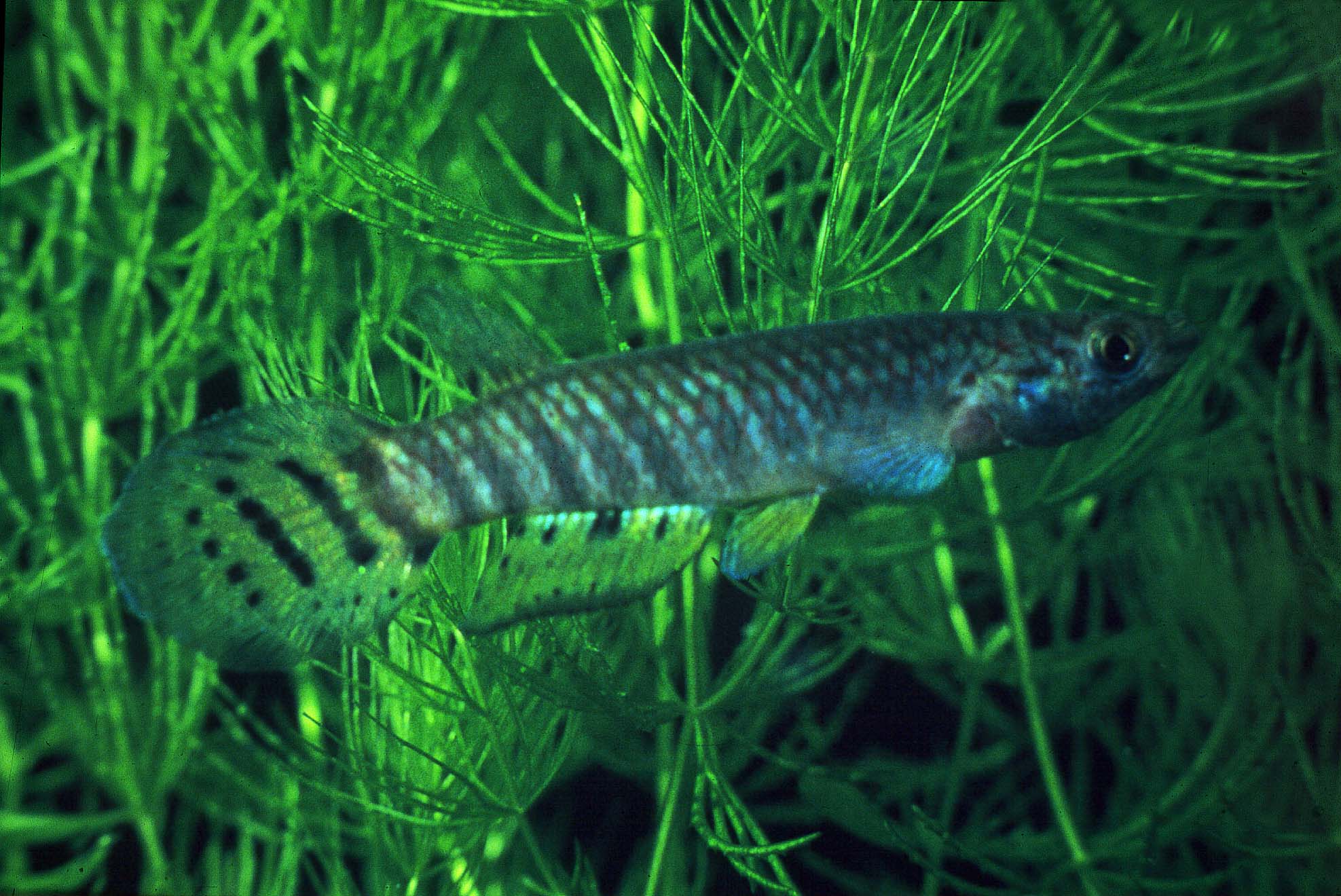
Colouration of the body is not brilliant but it more than makes up for lack of fine colours by the most unusual pattern of diagonal bars of a green/blue hue on a bluish silvery ground. The bars extend from just behind the operculum to the caudal peduncle. At times a very distinct darkish and wide band runs along the lateral line, this depending on the mood of the fish. At times highlights of a metallic blue show through between the bars. The eye is bold and golden and the mouth large. The dorsal fin is small and rounded in shape, the colour being a pale green with black markings, sometimes a pale orange colour may be present. The caudal is large and rounded and is greenish at the root to half of the fin the remaining half being of either orange in some specimens, to yellow in others, this is always overlaid with intense black bars and spots. The anal fin is well formed and is pale green to transparent with orange overcast and is overlaid with three black spots with fly specking of further black. A light edging of black occurs in some males when mature. Pelvics are transparent with just a suspicion of black. The ventrals are very pale green. Size of the male at maturity is given as 2″ but, in the aquarium, they tend to grow bigger than this although very slowly.
Description of the female: Very much like the male in shape but with paler colouration and the bars are not so permanent, they may fade altogether being replaced by a wide lateral band of black. Golden highlights may be present on the body. All fins carry some black markings, but the female does not carry the three conspicuous spots in the anal as does the male.
Maintenance and breeding: Does not appear to be too fussy regarding water conditions when adult, but preferably the water should be aged and of an acid reading and also soft, DH 4 to 10 German suiting, with pH in the region of 6.6. In these conditions the fish will show their best. Top lighting is appreciated but a surface cover of plants or floating mops should be provided. Feeding presents few problems; any live food being accepted. Dry foods may be ignored unless the fish are extremely hungry. There seems to be a wide toleration of temperature but a range of from 72 to 74F. is quite suitable for general maintenance and for breeding.
Breeding of the species is not very difficult when conditions are right. Small tanks may be used with a capacity of one to two gallons and set up with a peat base and one or two floating mops. One pair of fish per tank is sufficient. The adults should be conditioned on live foods for a few days before attempting the breeding, gnat larvae being a firm favourite. Spawning occurs in the mops but occasionally eggs are laid in the peat strata. Hatching occurs in 11 days at 72F. Eggs may be left with the parent fish or removed from the mops and hatched in separate containers, but I do not recommend this procedure, better results are obtained by rearing the fry with the adults, little if any harm comes to the small fry. A word of warning should be given here, it is fatal to move on the fry to new quarters at too earlier age even if the water conditions ect, are identical to their previous tank, they simply die off like flies, they should not be moved till they are about three months old. The usual fry foods may be fed, micro worms, brine shrimp, ect. filling the bill. Growth is slow after the first two months and sexing usually cannot be done till about the fifth month. I repeat that it is a far greater advantage to leave the fry in with the adults.
Summary: Truly a beautiful fish in good fettle and acclimatised to tank life. Rather shy at first but settle down nicely, they are not sluggish in behaviour as some of the genus are. I would venture to suggest that this is probably one of the best of the genus to keep regardless of what some authorities state. This species, formerly known as E.senegalensis (Steindachner 1870) is now known as E.spilargyreius. See Scheel, “Rivulins of the Old World” pages 375 and 407.
The first introduction of these fish came from the collecting activities of our David Blair in Ghana during 1969 and were distributed to various members of the Association.
References:
https://www.killi-data.org/mem221bersmysql/aa-header-services221.php?Rk_Hist=192%20rel=
http://www.killifishofwestafrica.co.uk/Ref_Library/Epiplatys/E.spilargyreius.htm
Epiplatys spilargyreius Congo CI 2025 (Wild)


Kaduna