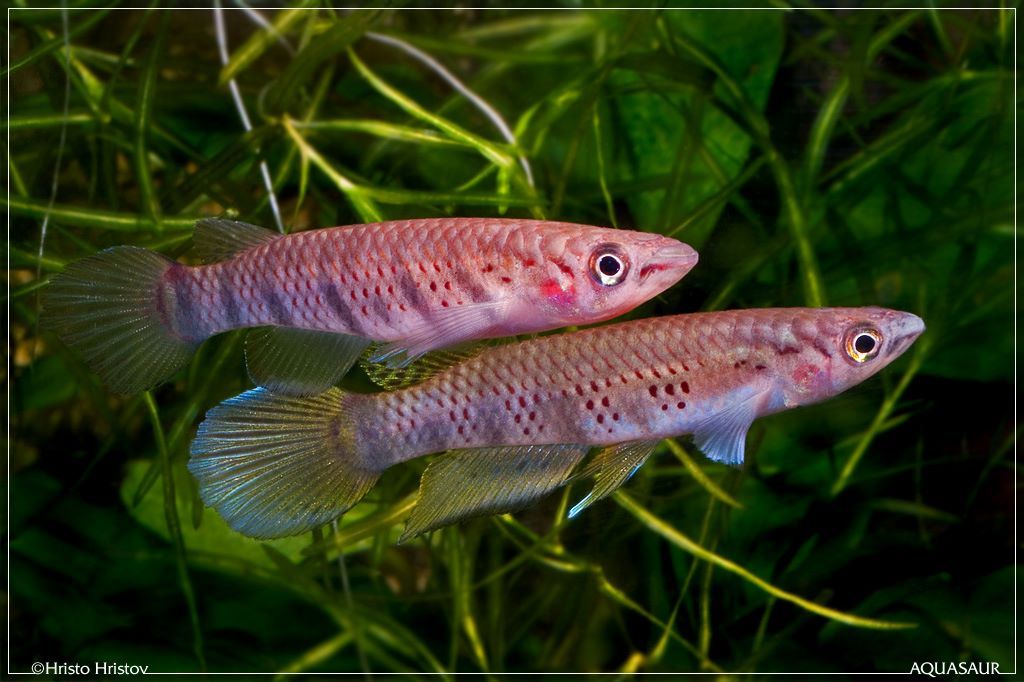
Epiplatys sexfasciatus
EPIPLATYS SEXFASCIATUS (Gill 1862)

Originally published as: B.K.A. Information Pamphlet No.47 June 1969
Habitat: Found in Rio Muni, the pair used to obtain this information were caught by J.J.Scheel in the river Rio Benito. The same phenotype also occurs in the Rio Lobe in the Southern Cameroon, very common in small streams of the forest.
Size: Male 75mm. (3″) Female 65mm (2.5″)
Colour and Description: The shape is typical of Epiplatys. This variety is certainly the most beautiful of the species so far seen.
Male: Greyish ground colour sides with metallic blue-green shine and numerous red spots. Fins yellow at base, blue in the mid-region, and brown borders. The bars on the body are only faintly visible. Lips blue and with a bright golden rim.
Female: Greyish ground colour with numerous red spots on the sides. The bars are almost always visible. Fins are without colour.
Care and Breeding: This pair were first bred by Scheel who reported that some of the fry died before reaching sexual maturity, this was believed to be due to bacterial infection. The same phenomenon was found here where approximately twenty per cent of the fry died just before reaching sexual maturity.
The pair were bred in a thirty inch tank filled with soft peaty water (D N H 3 ) at pH 6.0 and 24C, it is probably not sensitive to water conditions as long as aged water is used and the temperature kept within the region 23-26C. The eggs were laid in the roots of floating Pistia and in the upper part of a lump of java moss. Sexual maturity is reached after fourteen weeks. This pair were kept in a community tank for some time with seven Cheirodon axelrodi and four Apistogramma ramirezi. They were strictly surface bound and behaved peacefully and rather timid.
References:
https://www.killi-data.org/mem221bersmysql/aa-header-services221.php?Rk_Hist=211%20rel=
http://www.killifishofwestafrica.co.uk/Ref_Library/Epiplatys/E.sexfasciatus.htm