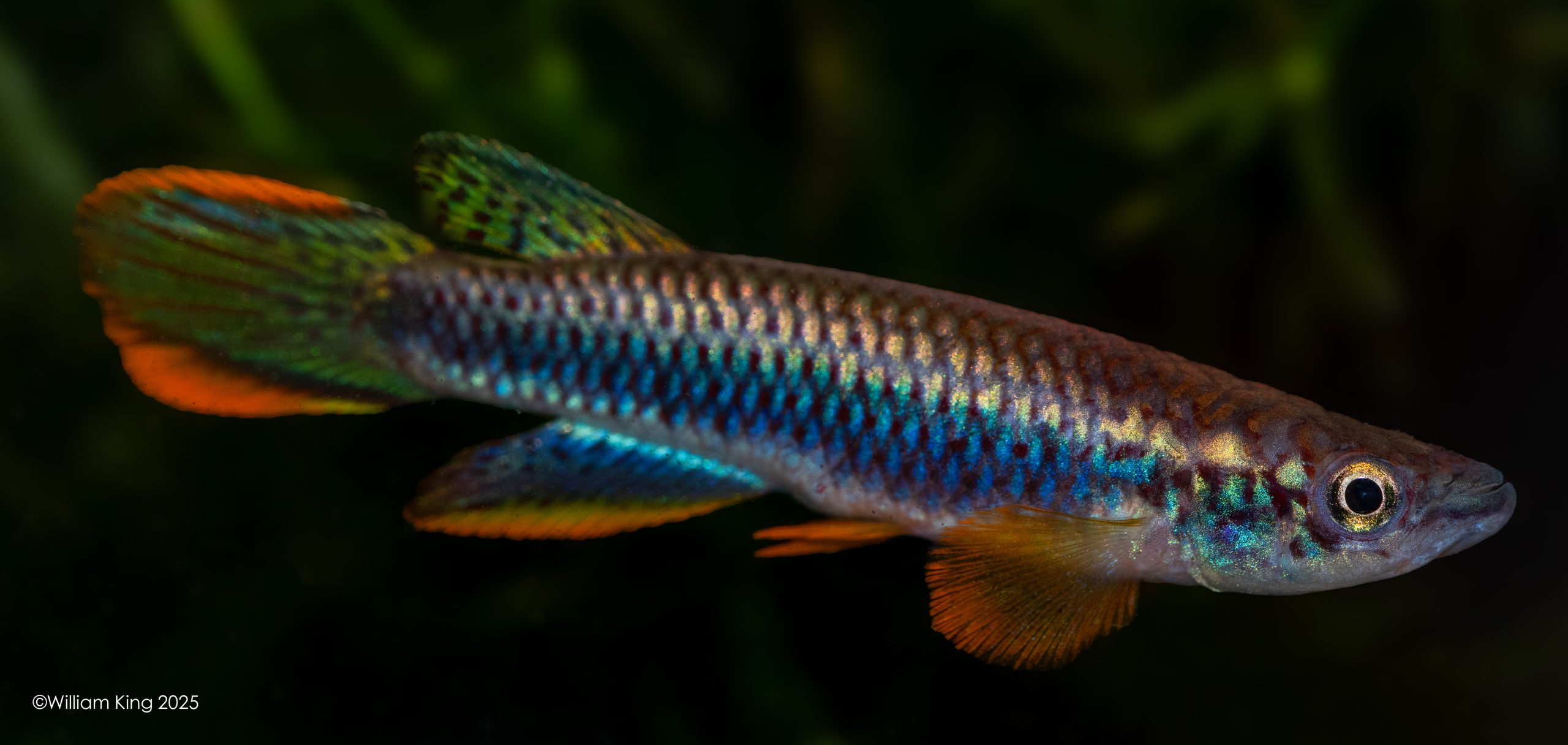
Epiplatys olbreichtsi
EPIPLATYS OLBRECHTSI (Poll 1941)
Originally published as: B.K.A. Information Pamphlet No.45 April 1969
Habitat: First collected from a small river on the Ivory Coast Liberian Border. This was the Maseni River a tributary of the Bon-de Boan River.
Description of fish: Male: Size up to 4 inches. The body shape is typical of the Epiplatys family with the bulky miniature pike like head tapering to the slim body.
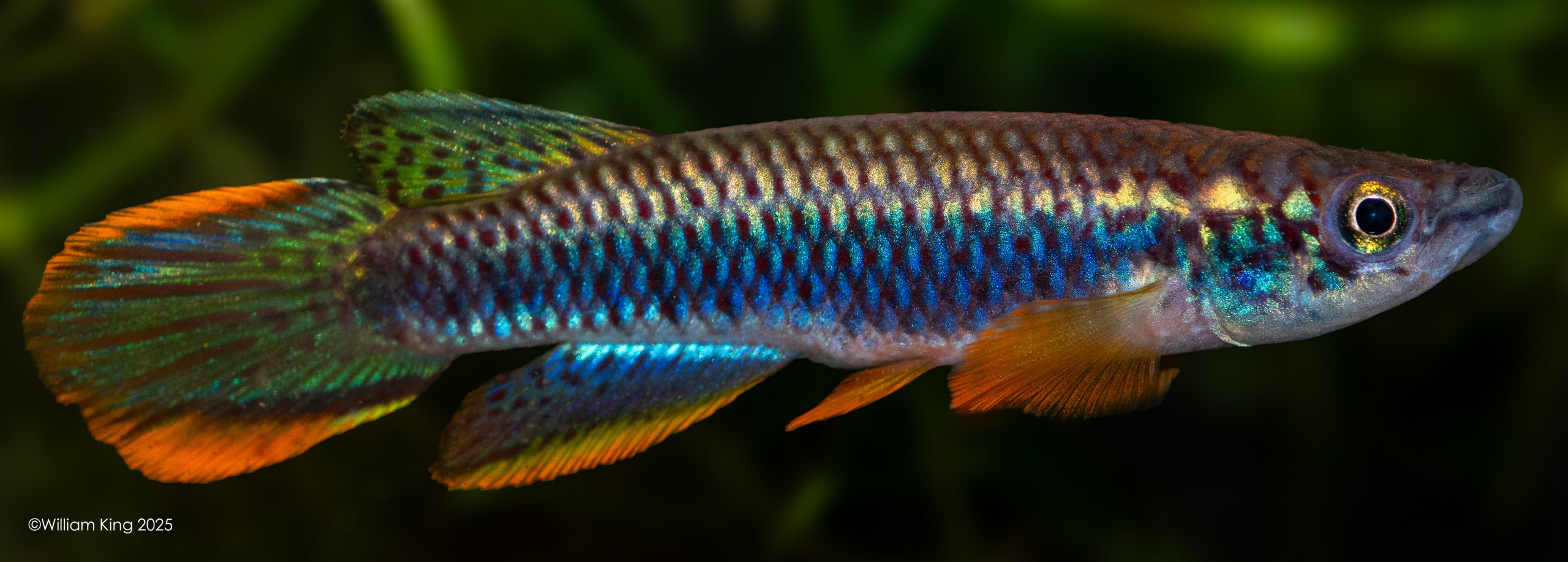
Colouration. The upper body is a light green shading to an emerald green in the central part of the body and light grey on the undersides. The hind part of the body is transposed with several oblique dark bands, these bands eight or nine in number are highlighted with brilliant blue short bars, covering perhaps two scales. The body is liberally covered with red spots on each scale. These spots are minute.
Fins. Unpaired fins are a brilliant ice blue – this colour may fade into a cloudy white when the fish is frightened or in poor health. The anal fin has an oblique dark bar on its outer extremity. The outer edges of the caudal and dorsal are edged with black. There are some red irregular marks on the head above and behind the eye. The upper and lower edge of the mouth is lined with black. The throat of the fish has a dark blue/black colouration.
Female: The female is as large if not larger than the male. A size more than 4 inches can be expected. Colouration is much lighter that in the male, the upper part of the body being a light fawn shading into a creamy white in the lower part of the body. The dark bands present on the posterior region of the fish appear to stand out far more than in the male. Fins are generally colourless except for red lining in the fin rays. These red lines are heavier and broken where the rays meet the body.
Breeding: To my surprise this fish produces an egg that is almost as small as that of Epiplatys dageti. Incubation time is as for Epiplatys dageti and similiar first foods such as the larger infusorians should be offered. This followed by newly hatched brine shrimp and micro worm. One thing I have noticed with Epiplatys olbrechtsi is that despite having every appearance of being a robust fish it is rather delicate in its spawning habits. By this I mean the eggs are either placed on the top of the spawning mop or in the trailing edges of the mop. From this I think we can safely assume that this fish would prefer to spawn in a plant such as Riccia or other floating plant. Courtship consists of a series of short rapid dashes by the male until the female is manouvered into the spawning site. The males are not over severe on the females. In fact, they appear to suffer no damage at all when spawning.
General Care: Not over fussy over water conditions. A fish I think for the planted tank where it will soon settle down and display its attractive ice blue coloration. All foods are taken including dried foods. The ideal temperature for this species should be 72 to 78F.
Summary: There is some confusion over this fish as to whether this is a valid species or merely a sub species of Epiplatys fasciolatus. It is very similar in body shape to Epiplatys fasciolatus but in coloration it is I think quite separate.
EPIPLATYS OLBRECHTSI Poll 1941
Originally published as: B.K.A. Information Pamphlet No.109 December 1976
Habitat: Liberia, Salayea, Zorzor. Biotope, small brooks. Water temperature 21 – 23C. DH 1 – 2 German pH 7.0 – 8.0.
Rediscovered in 1971.
Must not be confused with the species A. (E). fasciolatus olbrechtsi which has been in the hobby for many years.
Description of the male: Truly Epiplatys in form but very different from known species of this sub-genus in colouration. Basically, the adult male is, when viewed under natural light, a warm brownish red which at times appears to be almost purple. A darkish lateral stripe is present along the flanks which intensifies according to the mood of the fish. The throat region is blue, and the lips edged in a dark pigment which may be a very dark red or black. Scales lightly edged black. Eye green. Dorsally dark brown. Dorsal fin well towards the caudal as in all the ‘pike like’ killies. Dorsal fin light reddish with black or dark red outer margin, faint inner margin of blue. Caudal, olive with some small dark spots, upper and lower margins black or dark red, wider inner margins of blue white which may extend in some samples completely around the extremity of the caudal. Anal, olive to brown with an inner margin of white and a final outer margin of a dark hue-black or maybe very dark red. Pelvics black, ventrals very pale amber to clear.
Size attained in the aquarium: Reportedly up to 4 inches but a male of 3 inches total length must be considered a fair sample.
Colouration of the female: Dorsally greenish with a dark central line along dorsal ridge. Flanks olive with a pronounced lateral dark stripe which is crossed by several vertical dark bars which become more distinct towards the caudal. These bars are subject to the mood of the fish regarding intensity. All fins are clear except for the anal which may have a slight darkish shading along the distal edge.
Size attained in the aquarium: Up to 2.75 inches.
Maintenance and breeding: It is not too obvious that the water conditions remain in the biotope as discovered in 1971. It will be noted that the pH is extremely high for a killie although the DH is comparatively low. If the water chemistry is, as given for the biotope correct, then the species A. (E) olbrechtsi must be a very accommodating fish to keep in captivity. Those kept by the author have been maintained in soft water DH 2 – 4 and in water with a DH of 1. pH has been in the region of 6.8 with one pair and 6.3 with another. To date the best breeding results have come from water having the lowest pH and DH. Temperature has been, both for keeping and breeding, around 23C. with a fluctuation of 2C. Tanks should be of suitable size for so large a fish and one of 2.5 to 4 gallons seems about right. Lighting should be subdued and as for all Epiplatys, adequate top cover provided. The base of the tank should be dark and under such conditions the species will show to its best advantage.
Breeding presents no problems although long layoffs from egg production seems to be the rule. The eggs are moderately large and almost transparent, these show up well on green nylon spawning mops. Mainly, eggs are laid close to the water surface, the eggs may be collected once per week, water hatching is the method employed.
At times young fry appear in the spawning tank but few manage to escape the parents’ mouths. Eggs hatch in about 15 days at a temperature of 21C. and the young fry are easily catered for as they consume any type of live food offered which they may take into their mouths in comfort. Growth is not rapid even with copious feeding and space and grading becomes necessary to prevent larger fry consuming their smaller brethren. Young A. (E) olbrechtsi look a little different from the parent fish in that both sexes are heavily striped vertically with a wide dark lateral stripe and only by observing the more pointed dorsal and anal fin may the sexes be told apart. It is about six months before the beauty of the males develop and some 12 months before they are in full glory.
Summary: A very remarkably coloured fish, being unusual in its colour and patterning, quite unlike any other Epiplatys form. Very pretty in its adult stage but tending to be rather retiring. Should be easily managed by the novice.
References:
https://www.killi-data.org/mem221bersmysql/aa-header-services221.php?Rk_Hist=928%20rel=
http://www.killifishofwestafrica.co.uk/Ref_Library/Epiplatys/E.olb.olbrechtsi.htm