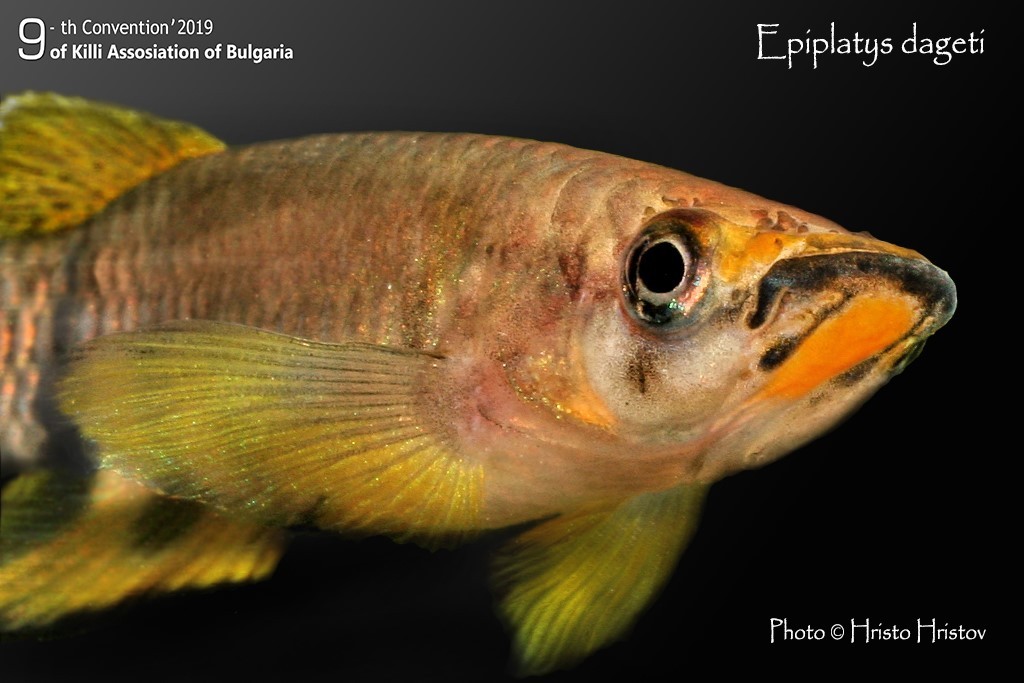
Epiplatys dageti
EPIPLATYS DAGETI (Poll 1953)
Originally published as: B.K.A. Information Pamphlet No.80 April 1972
Biotope: Native to S.W. Ghana and parts of the Ivory Coast where it inhabits swamp areas close to the coastal regions, may have a wider range than at present thought.
Description of the male: One can again find various colour “strains” of E.dageti depending on the locality from whence derived. The following description is for an aquarium strain. Dorsally grey to grey green. Flanks with a decided middle green overcast upon which some light blue patches appear and some metallic green spotting; superimposed are five almost complete dark bars which may be of a dark brown to black depending on the mood of the fish. These dark bars enter the root of the anal fin. Head flattened with trace of the vestigal eye. Snout pointed, mouth upturned, eye bold with yellow iris. Throat in some specimens red but this colour not prevalent among aquarium kept stock, more usual colouration being chrome yellow to almost white. Belly region brownish red to very pale red with some yellow highlights. Dorsal small, greenish at the root turning to pale rust red with minute fly specking of black. Caudal emerald, green with some black and minute rust red spotting. Lower edge of caudal drawn out to form a slight filament and being edged by a wide margin of black. The anal fin greenish blue with black specking and having an outer margin of black and being slightly filamented. Ventrals slightly tinted green and having a black edging. Pectorals large and are almost transparent.
Description of the female: Has some similarity to the male but all fins being rounded and transparent.
Size attained: Aquarium specimens reaching some 2.5 to 2.75 inches for males, females rather smaller at 1.5 to 2 inches.
Maintenance and breeding: Not at all difficult to keep in the aquarium, water conditions being far from critical. Does not do very well when included in an aquarium of mixed species. Disturbance at the water surface by aeration or other means disliked very much. Surface cover appreciated which be of mops or natural vegetation. All foods accepted.
For spawning floating mops may be used, peat fibre hung over the tank side but by far the finest results have been obtained by using sphagnum moss completely submerged but allowed to rise about halfway of the water depth. For some reason this material seems to simulate the spawning urge, maybe reminding the species of its swamp-like natural habitat, A rise in temperature welcome but not essential, 74F. being a happy medium for both breeding and general maintenance. Eggs medium large and may be collected over a period and hatched in suitable shallow containers, this is probably the best method of propagation as the adults are very prone to devouring the fry. Eggs hatch in about 10 days at 72F., fry may be fed on micro eels but perhaps infusoria should be fed for the first few days before graduating to larger forms of live foods. Not a rapid grower and may take some 10 to 12 months before becoming fully developed. Rather a long-lived species.
Summary: A very old favourite which masqueraded under the title of Epiplatys chaperi for a good many years. Two known subspecies are E.dageti dageti and E.dageti monrovia. A charming little fish which has always had its champions.
References:
https://www.killi-data.org/mem221bersmysql/aa-header-services221.php?Rk_Hist=1054%20rel=
http://www.killifishofwestafrica.co.uk/Ref_Library/Epiplatys/E.dageti.htm