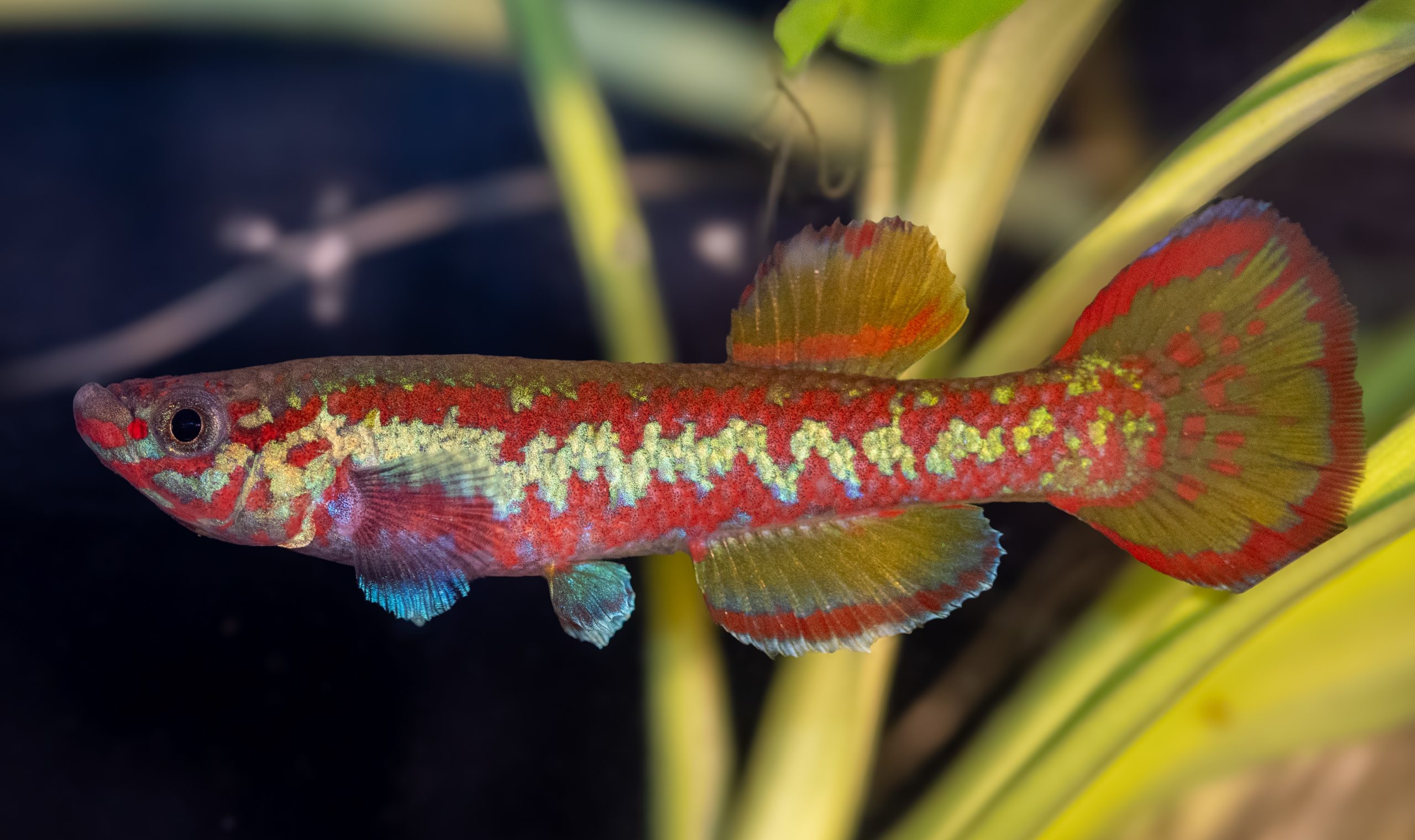
Aphyosemion exigoidium
Aphyosemion exigoideum (Radda et Huber 1977)
Originally published as: BKA Information Pamphlet 116, 1977 Fred Wright, TE/BKA
Habitat: W. Gabon in rainforest of the lower Ngunie. Water temperature 21.9°C, total hardness 12o German.
Description of the Male: Typically of the genus Aphyosemion in shape and in behaviour. Growth in captivity to about 21⁄4″. Dorsally light olive green, flanks pale to deep ochre upon which, from the ventrals to the pelvics, are two rows of clear red spots: From the pelvics to the caudal peduncle are many irregular, almost crescent shaped, red to crimson markings which become more numerous towards the peduncle. Head is ochre yellow with two vermiform red marks at the rearward part of the eye also two vermiform red markings below the eye. Eye bold and golden with black iris. The belly region is brick red. Caudal fin basically green to yellow-green upon which, in the centre, is imposed three vertical crescent shaped rows of large red to crimson spots. An inner margin is present which encompasses the entire fin and is crimson in colouration. A final margin to the upper and lower parts of the fin is of a blue-white, there is also a faint (in some samples) black edging to the. rearward extremity of the fin. The dorsal is moderately large, greenish at the base for one third of the width and orange for the remaining part which is divided by a curving crimson horizontal line of uniform width, a red spot is present in the rearward part of the fin. The anal fin is of a grass green colouration with a number of red spots at the root, a single large red spot at the rearward edge, an inner
margin of the same colour and an outer margin of blue-white. Pelvics are grass green with two red edges and tipped blue-white. Ventrals light transparent orange tipped light red and white. All colours become very intense when the fish is active.
Description of the Female: Dark olive to dark brown. Fins hyaline with some bluish cast. Growth to about 21⁄4″
Maintenance and Breeding: Easily maintained in a variety of water conditions. Feeding
is not difficult as all types of living foods are accepted. Dry foods and beef heart will also be taken in moderation. The species seems to settle down into any type of surround- ings, from bare tank to furnished. A pair of fish are not particularly active and
spawning on nylon mops which are floating is not too frequent. The best results are achieved by the use of sphagnum moss and peat moss, eggs are laid in both media. Eggs from sphagnum may be collected once per week and eggs in the peat moss are collected complete with the peat and partially dried, by this method one has a more uniform
hatch. Eggs water incubated take some 21 to 23 days to hatch. Eggs in peat which has had the drying treatment requires some 16 days before hatching is possible. The fry are relatively small upon hatching and may require infusoria type foods for a few days before graduating to the usual first fry foods. Growth not particularly rapid and suggests that the species may well be long lived in the aquarium.
Summary: Undoubtedly one of the most beautiful fish derived from the Gabon Radda- Huber expedition of 1976. Keeping this fascinating species is easy but breeding in quantity may present some problems. An acquisition for any killi-keeper.
Literature: C. Din Tientand .Stab in Gad die Mayunbe-Berge. Radda et Huber

References:
https://www.killi-data.org/mem221bersmysql/aa-header-services221.php?Rk_Hist=1304%20rel=
http://www.killifishofwestafrica.co.uk/Ref_Library/Aphyosemion/A.exigoideum.htm