Aphyosemion elegans
APHYOSEMION ELEGANS (Boulenger 1899)
Originally published as: B.K.A. Information Pamphlet No.82 June 1972
Biotope: Native to the Central Congo Drainage where it inhabits small bodies of water, shallow in character in forested areas. Also occurs in shallow moving streams in forested regions of the Central Congo.
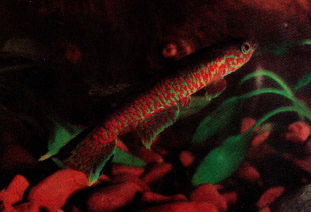
Description of the male: A typical A.christyi type of fish to which species A.elegans is closely related. The iris is green and there are two vermiform streaks behind the operculum of crimson. Dorsally olive green. The basic body colour is greenish yellow and is covered by many fine spots of red almost covering the basic body colour sometimes giving the fish a chequered appearance. The belly region is reddish. The dorsal is triangular in shape being spotted at the root with a thick margin of dark maroon (which appears as black when viewed from a distance) and having a final outer edge of blueish white appearing as primrose yellow under some lighting. The caudal is strongly filamented, more so in the lower half. Centre of the caudal is pale green being very finely spotted with red. The top half is edged thickly with dark maroon and a final outer margin of blueish white. The lower half has a margin of blueish and a final thin margin of dark maroon. The anal is pale green at the root with a few red spots and almost transparent at the outer edge. Pelvics transparent and the pectorals flushed orange. It is interesting to note that all the regions which are given as being dark maroon appear as black till viewed very closely.
Description of the female: A rather nondescript creature being a dull brownish red with some dark spotting on the unpaired fins which are +otherwise colourless. Size to about 1.5″.
Maintenance and breeding: A fairly easy species to keep and to breed given the right conditions, which are not too exacting. Subdued light is of benefit as the species is rather scary especially if placed in new surroundings. Not too fussy in regard to feeding or in water conditions. A pH of 6.8 to 7.0 with a DH of about 4 German seems to suit. Temperature should be on the cool side, 70 to 72F. These conditions are suitable for breeding as well as general maintenance. Most foods are readily accepted including the dried variety. Live foods should be on the small side, sifted daphnia and grindal worm being ideal. Young pairs rapidly come into breeding condition and will, if allowed, commence spawning at the 1″ stage although few eggs are laid at this size. Eggs are laid on both top and bottom mops, there seems to be no preference for either. Eggs will also be laid in the substrate if this consists of peat fibre or other loose material. Eggs are small and slightly adhesive and hatch in from 12 to 16 days at a temperature of 72F. Eggs collection can be practised or the eggs left to hatch in the spawning tank together with the breeding pair. Few eggs may be eaten but normally this is quite a prolific species that enough young fry are obtained to satisfy the needs of the aquarist. Top cover should be given if the young fry are left with the parent fish. Growth is not rapid for the first two months but for some reason growth rate speeds up after this period. The males start to colour when about three months old, sexing can be done before this time by noticing the extension which occurs in the dorsal of the males.
Experience so far, with this species is that there is a very marked sex ratio in favour of the males, exact numbers have yet to be determined.
Summary: A very pleasing fish to have which has certain characteristics to endear it to the Killie keeper. As stated it is similar to A.christyi in form and in behaviour and is in fact a species in the “CHR” complex. It, no doubt, will become a firm favourite when fully established in the Association.
References:
Killi-Data A.elegans
Killifish of West Africa A.elegans
