Aphyosemion cognatum
APHYOSEMION COGNATUM (Meinken, 1951)
Originally published as: B.K.A. Information Pamphlet No.36 June 1968
Habitat: Tropical West Africa (Lower Congo). This species may be found in small bodies of water, pools, streams, ditches ect.
Size and Colour Description: Male size 2.25″ to 2.5″
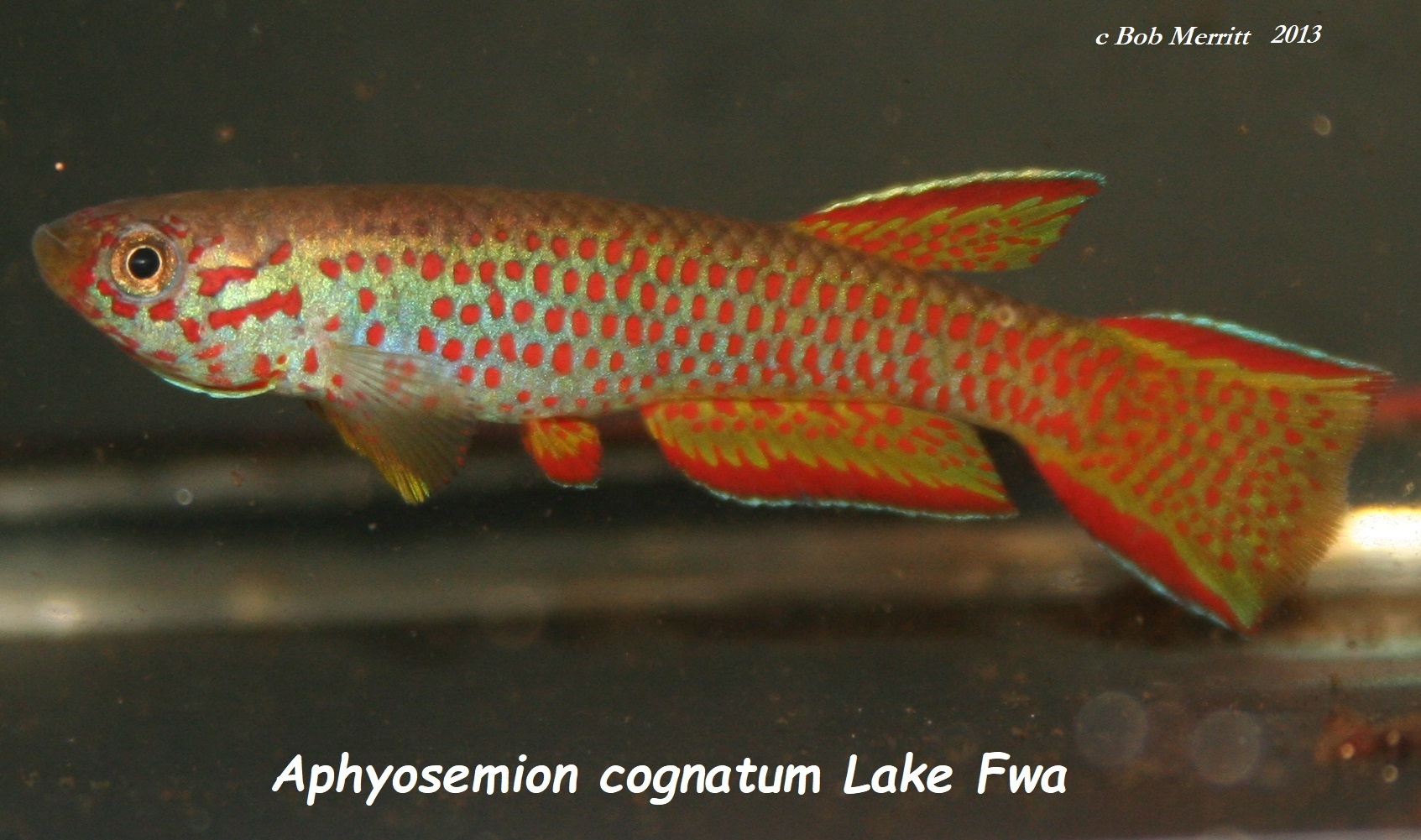
The body colour is basically a light yellow deepening to a tan across the back, being paler in the belly area, front half of the body also has a blue green tinge, this is strongest on the gill covers, it is covered with a number of red spots that may be so intense that they run into broken bars running vertically down the body.
Fins: Dorsal and anal base a pale yellow, both having red spots in them and edged with red, the dorsal has a pale blue outer edge. The caudal has a pale yellow centre changing to pale blue with red spots, the top edge is the same as the dorsal, with the bottom edge red, the tips of the caudal are pale blue. All the fins have red spots that may run into broken bars on them except pectorals which are orange.
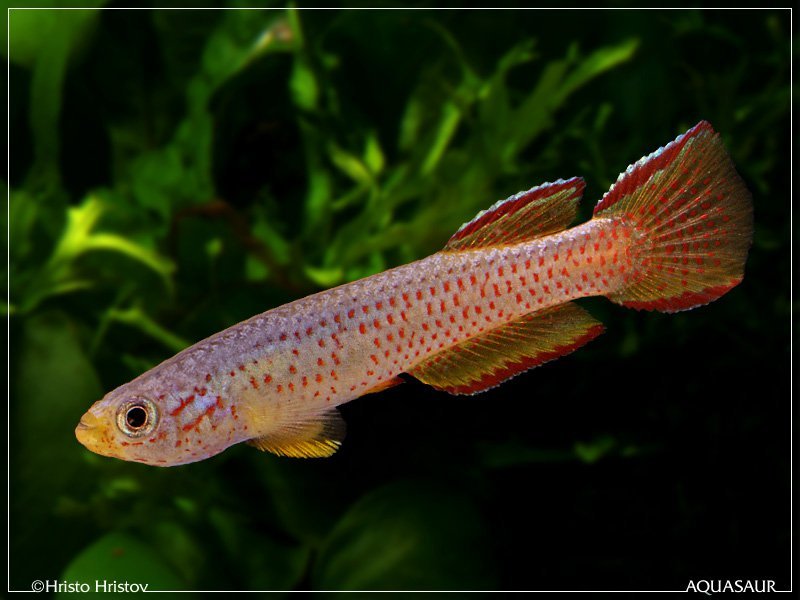
Female: The body colour is a washed out yellow to tan, both body and fins are scattered with a few red spots. Size to 2.25″
Care and Maintenance: An Aphyosemion I find will do far better at a lower temperature than most that I have kept. Having spawned better +as low as 68-73F. (20-23C.)
Most Aphyosemions like soft water 50 p.p.m. or lower and 6.4-7.0 pH. so do not worry if you have not got soft water with this fish. The fish are conditioned on grindal worms and a number of frozen foods – prawns, shrimps, crab ect. and when available daphnia, blood worms and anything else I can get, also commercial dried food.
The fish are top spawners and as with most killies it’s best to run a trio if you can, just in case the female is not in the spawning mood, with two females in the tank there is less risk of ending up with an odd male. I pick the eggs off the mops and store in hard plastic boxes with a little Methylene Blue, this helps cut down the light. The eggs hatch between twelve and twenty days. If the eggs look like they are not going to hatch a little dry food or micro worm can be added, alternatively an air stone will help crack the shells.
The fry are small, but will take freshly hatched brine shrimp as a first food and then micro worm and onto sifted daphnia and then dried foods ect. I find them slow growing but fish that are well worth the trouble when looking at the end result.
References: