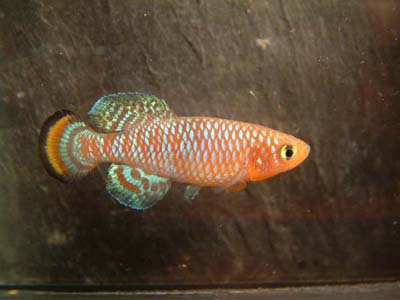
Nothobranchius rachovii
NOTHOBRANCHIUS RACHOVII ( Ahl 1926 )
Originally published as: B.K.A. Information pamphlet No.8
Systematics: N.rachovii was described in 1926 by the German ichthyologist Ahl on the basis of four specimens from an aquarium strain. This strain was thought to originate from Beira, Mozambique.
Distribution: N.rachovii has been found from Beira southwards in the low veldt region into the Kruger National Park, eastern Transvaal where it is sympatric with N.orthonotus. (Jubb, 1969). Roloff (1978) always found N.kuhntae and N.mayeri in the same pools as N.rachovii in the Beira area.
Description of male: The thick set body is brilliant turquoise with red streaks edging the scales. The belly has a pale golden lustre.The caudal has a black outer band with a bright orange submarginal band and turquoise and red streaks at the base. The dorsal and anal fins are turquoise streaked and dotted with red. The ventrals are turquoise with a large red spot at the base. The pectorals are transparent olive, red at the base with a turquoise margin.
Length is to approximately 5 cms.
Description of female: As usual with this genus the female is a washed-out pinky-grey with none of the male’s brilliant colouration.
Length is to approximately 4 cms.
Maintenance and breeding: As with most Nothos N.rachovii should be offered the usual selection of live foods; dried foods are not readily accepted, if at all Water conditions are not critical; Roloff (1978) reported a pH of 7.1 and a DH of 8.3 in the natural habitat so domestic tap water will usually suffice. a wide temperature range is tolerated with 20 to 23C. being optimal.
A small tank will suffice for a trio; ideally there should be more females than males as males are heavy drivers. The most usual spawning medium is peat; only a narrow layer is required as eggs are deposited only just below the surface. Fine sand may also be used; in this case after spawning the sand should be sifted through a net in which the eggs will be retained. Spawning may begin as early as just four weeks after the fry hatch and will continue through life, though females should be separated temporarily if they start to show signs of stress. The normal procedure after the collection of the eggs is to store them in slightly damp peat for six months, and then add water. Not all eggs will hatch when first wetted so for maximum yield the peat should be re-dried and wetted periodically. Ostrow (1977) presents an interesting variation on this method; eggs are incubated in water for three weeks after collection, with the first week in water containing 1% acriflavine at a concentration of 8 drops per litre. After this period the eggs are clearly eyed and are then transferred to damp peat moss for a week, after which they will hatch when returned to water. Whichever technique is used will result in small fry which should be feed for a day or two on infusoria before going on to brine shrimp and the usual range of foods. Growth thereafter is extremely rapid. The lifespan is about one year, occasionally as long as 18 months.
Summary: N.rachovii has frequently been described as the most beautiful freshwater fish in the world, and with some justification. Although not especially easy to raise, and thus not a good beginners fish, this beauty has ensured its survival in the aquarium for many years and is likely to continue to do so.
References:
https://wildnothos.wixsite.com/wildnothos/rachovii
Ahl, E. (1926). Neue oder selten importierte Fische. Blater Aquar. Ter. Kde. 37, 222.
Jubb, R. A. (1969). The Nothobranchius (Pisces, Cyprinodontidae) of Southern Africa and a new species from Lake Chilwa, Malawi. B.K.A. Separatum, 11pp.
Ostrow, M. E. (1977). A dramatic reduction of egg incubation time for the fire killie. Trop. Fish Hobbyist 25(5), 22-32.
Roloff, E. (1978). Three species of Nothobranchius from Beira. .J Amer. Killifish Asoc. 11(5), 147-156.