Nematolebias whitei
NEMATOLEBIAS WHITEI (Myers 1942)
Originally published as: Cynolebias whitei B.K.A. Information Pamphlet No.4
Accepting and breeding a New Species can be an exciting if not a frightening experience.
In September 1964 I was sent eggs of Nematolebias whitei, which were a new species at that time, by the late Mr. Ted Willis, Chairman of the New Species Committee. Cynolebias species were what I was particularly interested in at that time and actually I still am.
To the best of my knowledge these eggs came from a contact in West Germany and had been bred there for at least two years before Mr. Willis obtained any. The species had been discovered by a Lt. Col. White during an expedition to Brazil in 1956.
The German contact stated that the eggs were ready to hatch, the water he used was pure rainwater, and the fry could be fed on Brine Shrimp as a first food, which all sounded nice and easy.
Pure rainwater in the midlands? you’re joking! we can of course collect fairly decent rainwater after a few days downpour but I simply couldn’t risk these eggs in that concoction. As a member of the New Species Propagation Committee, I was obligated to hatch these eggs, grow them to breeding size, spawn them and make the first three dozen fertile eggs available to the Management Committee.
Our tap water is very hard, 18 degrees (Clarke) at least, so that was out of the question. The water used was tap water passed through a Permutit Water Softener, which reads less than 1 degree (Clarke), plus additional tap water to give a reading of 56 p.p.m. (English) which is just a little under 4 degrees (Clarke). The pH was 6.8 to 7.0.
I had searched the peat for eggs but couldn’t find any, so I was both apprehensive and excited at the prospect of trying them. An all glass contained was used, filled to a depth of 5″ and the temperature raised to between 70- and 75-degrees F. The peat was then scattered all over the surface and after a while some of it gradually sank to the bottom, I don’t think I left that container for many seconds waiting and watching. An hour and half passed by before the first fry appeared yet within seconds there were numerous young fish swimming in jerky movements towards the surface to fill their swim bladders with oxygen. As soon as this was accomplished, they became free swimming and within a few hours were searching for food, Brine Shrimp was fed to them the following day and then only sufficient to ensure that none would be left to foul the water.
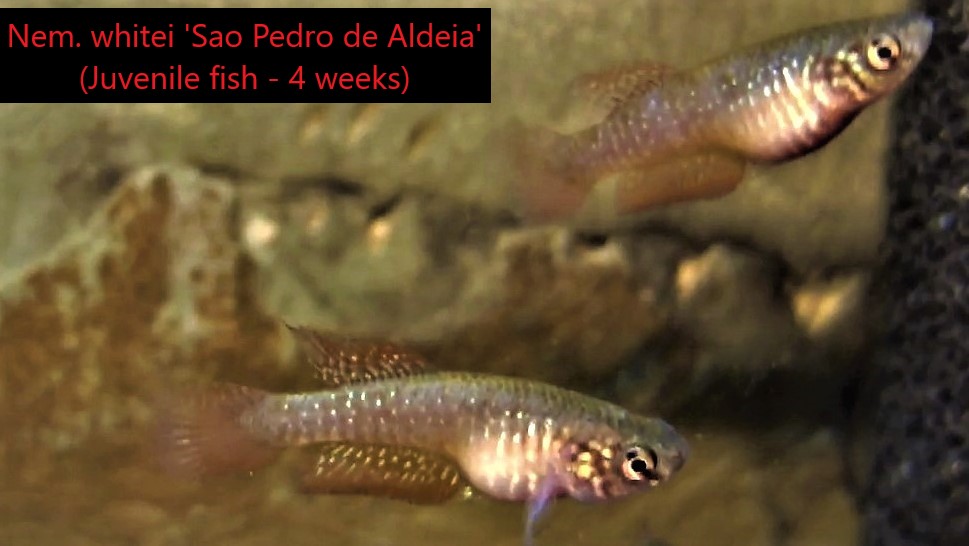
The fry, nearly fifty in all, grew rapidly on a diet of Brine Shrimp, Micro Worms and later on Grindal Worms.
By the tenth day the glass containers were becoming dirty, not foul but dirty, and the fry needed moving to larger quarters. These I had available in the shape of two tanks, 18 x 10 x 10, which contained water of 5 D.H. (Clarke) and a temperature of 75F., just the job, if you’ll pardon the expression.
Nevertheless, I still had to be careful, strictly speaking these fish were not my property so in order to avoid anything drastic happening I transferred only two fry into each tank. It was late afternoon when the fry were moved and by the evening they still seemed in good shape and swimming quite happily in their new surroundings, however I decided to wait until the following day before completing the operation and moving the remainder.
Very early next morning, (I do get up early some mornings) I dashed into the fish house but, sad news, the four fry were dead. My heart sank to the floor, Calamity! What had gone wrong? no reason that I could think of ! Drastic and thorough checks of everything were made. Temperature, pH, Hardness, I even thought of dissolved solids. The only difference I found in comparing both containers was that the tanks were 1 degree of Hardness higher, so both tanks were thoroughly cleaned out and set up exactly as the containers the fry were in.
Once again only two fry were placed in each tank and this time the move was successful and all the youngsters continued to thrive. Apart from that difference in Hardness I have never yet found out why the fry in the first move died. This observation is made purely in an endeavour to emphasise the extreme care that must be taken when moving these fish, both fry and adults, from one container to another. An Association friend once lost three adults pairs in transferring them to another container.
More success came later when I had five adult pairs in breeding aquariums. If you have not yet come into contact with these beautiful fish I would like to try and describe those I had to you.
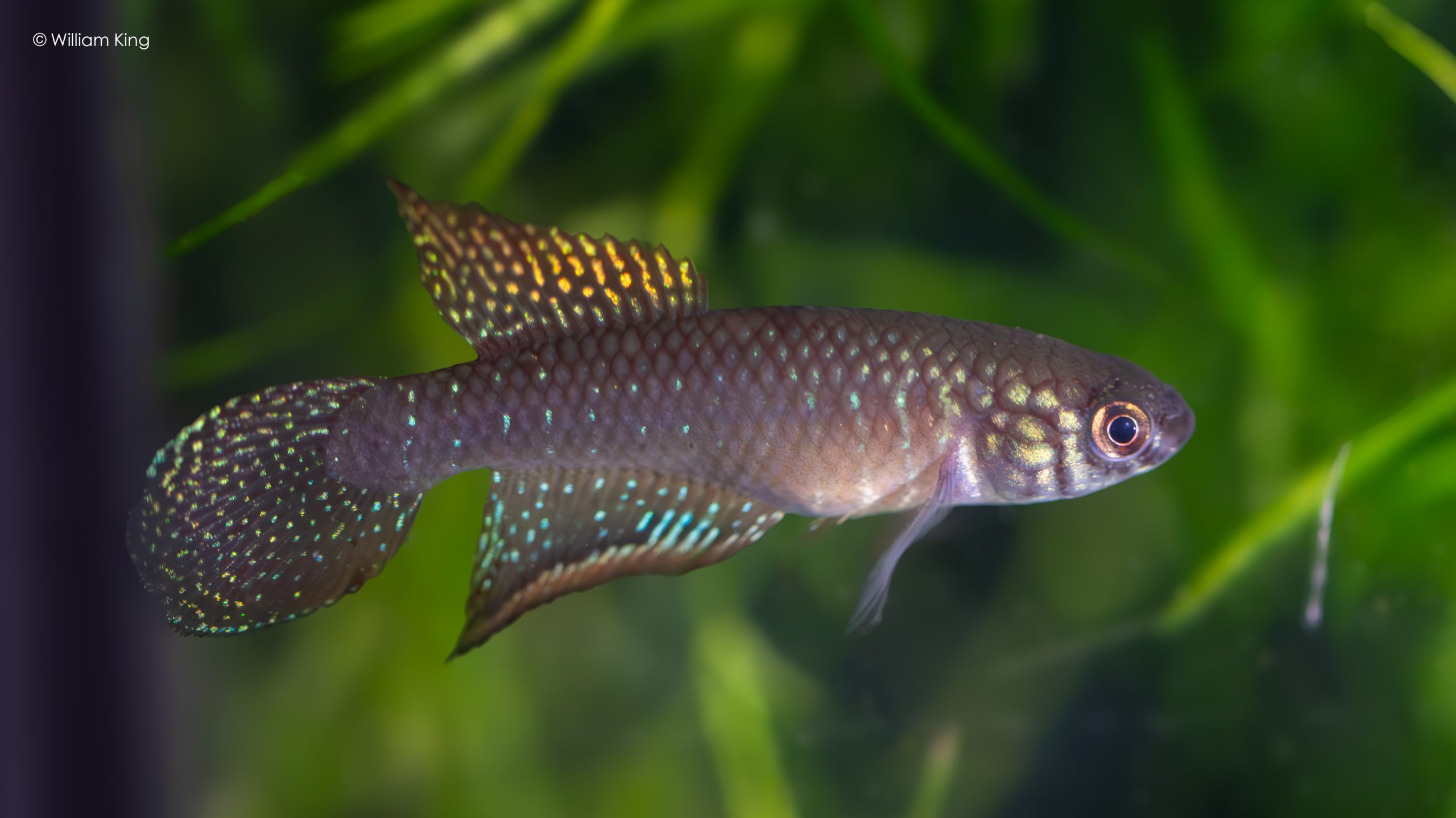
The males were approximate three inches long and beautifully coloured, the overall body colour was a Rusty Brown with Bluish to Gold spots scattered throughout, the fins being a more Reddish Brown with Gold spots. The overall shape is very similar to the Betta splenden but with larger pectoral fins, it has in fact been referred to many times as the Fighting Toothcarp due to this resemblance. The female of the species is smaller and less colourful and has a black spot in the centre of the body and also at the base of the caudal peduncle.
My first attempt at spawning was made using 1 male to 2 females and Nylon wool mops as the spawning medium. I didn’t get a great deal of eggs with this method but none the less I did obtain sufficient to supply Association Members who wrote for them after I had made my obligatory supply to the Management Committee.
The fish had been fed on as large a variety of live foods as I could obtain for them, Grindal and White Worms, Gnat Larvae, Daphnia, etc.. but I would like to add a word of warning here, I did lose a few pairs later during the winter months through overfeeding White Worm. Two days after I had noticed a swelling in the belly region the fish died. I sent them away for a post mortom and the examination report stated: – Bactorial infection of the gut caused blockage, subsequently death occurred.
As you can gather from the report, I had a great deal of hard luck with my new species but one learns from these experiences even if one pays dearly for the privilege of learning.
A later method of spawning these species resulted in greater success. For this method peat was used as the spawning medium and the fish spawned more readily, their colours were more intensified, in all probability because they felt more at home in peat which offered them a place to retreat if they were frightened. Some of you may ask why I did not use sand? I did, but found the fish were too frightened to settle down to spawn and the sand sent the hardness of the water sky high in the space of a few weeks.
With peat I freely admit, the eggs are more difficult to find but they do not succumb to fungus as did the eggs collected when I was using Nylon wool mops. After spawning the peat is dried for three months in the usual manner or method. After this period the peat can then be flooded to a depth of three inches, no more than three inches as I did find this is important. At this depth the fry can reach the surface much easier and not so many are lost in the first hours of hatching. The depth can be increased when the fry are about a week old, but again I must stress the importance of adding water of the same condition as that which the fry are already in.
NEMATOLEBIAS WHITEI (Myers 1942)
Originally published as Cynolebias whitei B.K.A. Information Pamphlet No.18 November 1966
Habitat: Found in water holes, not permanent streams or pools in the state of Rio de Janeiro. An annual species, living for only a short period until the waters dry up. The bottom of the water holes contains black sub-soils surrounded by Hair grass and dense reeds. Found also near the city of Rio de Janeiro. Named after Lt.Col.White who discovered many Cynolebias species.
Description: Male: The body is long and tapering to the caudal fin. The head is large and thick set. The mouth is upturned and the eyes large. Basic body colouration chocolate brown, spangled with many gold spots, spreading through to, and into the fins. The more intense colour is in the anal fin. Belly region slightly paler and rather more than coloured. The colour is variable to the conditions it is kept under. The dorsal and caudal are heavily sprinkled with spots and later streaks of gold. The anal has a broad band of gold, this is sometimes lacking in tank breed fish. Caudal rounded similar in colour to other fins, edged with border of red brown to black. Dorsal and the anal fin are long and pointed, reaching well past the caudal peduncle. Pelvic fins large, dark brown and paddle shaped.
Female: Considerably smaller, darkish brown in colour, with dark brown to black spots midway along the body region and at the base of the caudal fin. All fins small and rounded. Has a short set body rounded in shape not tapering as in the male.
Size: Males will attain 4″ with good feeding in the early stages of life, but a fish easily stunted. Females 1.5″. Males start to spawn when only 1.5″, females start to produce eggs when only 5/8″ but this may retard the growth if attempts are made to early.
Feeding: Dried foods very seldom taken, but can be fed as a roughage, when the fry are growing on. Mosquito larvae, white worm, tubifex and daphnia taken with relish. Species should be fed little and often as this species is prone to internal troubles at times through over-feeding.
Breeding: This fish is classed as one of the peat divers. They dive deep into their medium to spawn. Have also been spawned on silver sand with great success, eggs are collected and dried in peat as with most of the so-called annuals. It has also been known to hatch from the egg without drying i.e. kept in water for the whole of the incubation period, but only limited success.
Small 12″ x 8″ x 8″ breeding aquariums are used, with peat moss as the spawning medium. Eggs are dried for a minimum period of three months. The fry grow very quickly taking micro worm and Brine shrimp as a first food. This species does not take kindly to many water changes. Shallow water is used for the first few weeks, later this can be increased.
References:
https://www.itrainsfishes.net/content/nematolebias_whitei_001.php