Fundulopanchax sjoestedti
FUNDULOPANCHAX SJOESTEDTI
Originally published as: B.K.A. Information Pamphlet No.25 June 1967
Habitat: This fish is found in the Niger Delta area of tropical West Africa. The males can be very quarrelsome and sometimes the females too, so care must be taken in the aquarium to keep fish of equal proportions together. Temperature should be in the range 70 to 74F. Keeping the fish at higher temperatures may result in considerably shortening of the life-span.
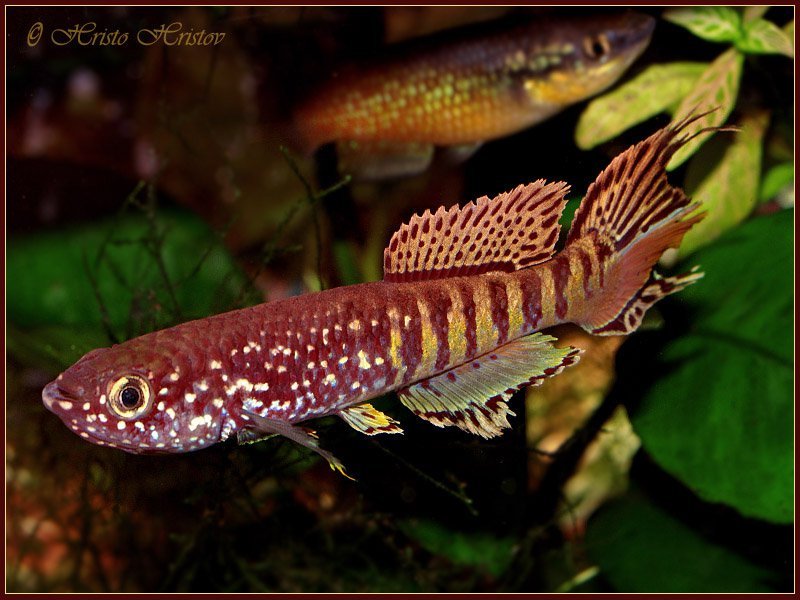
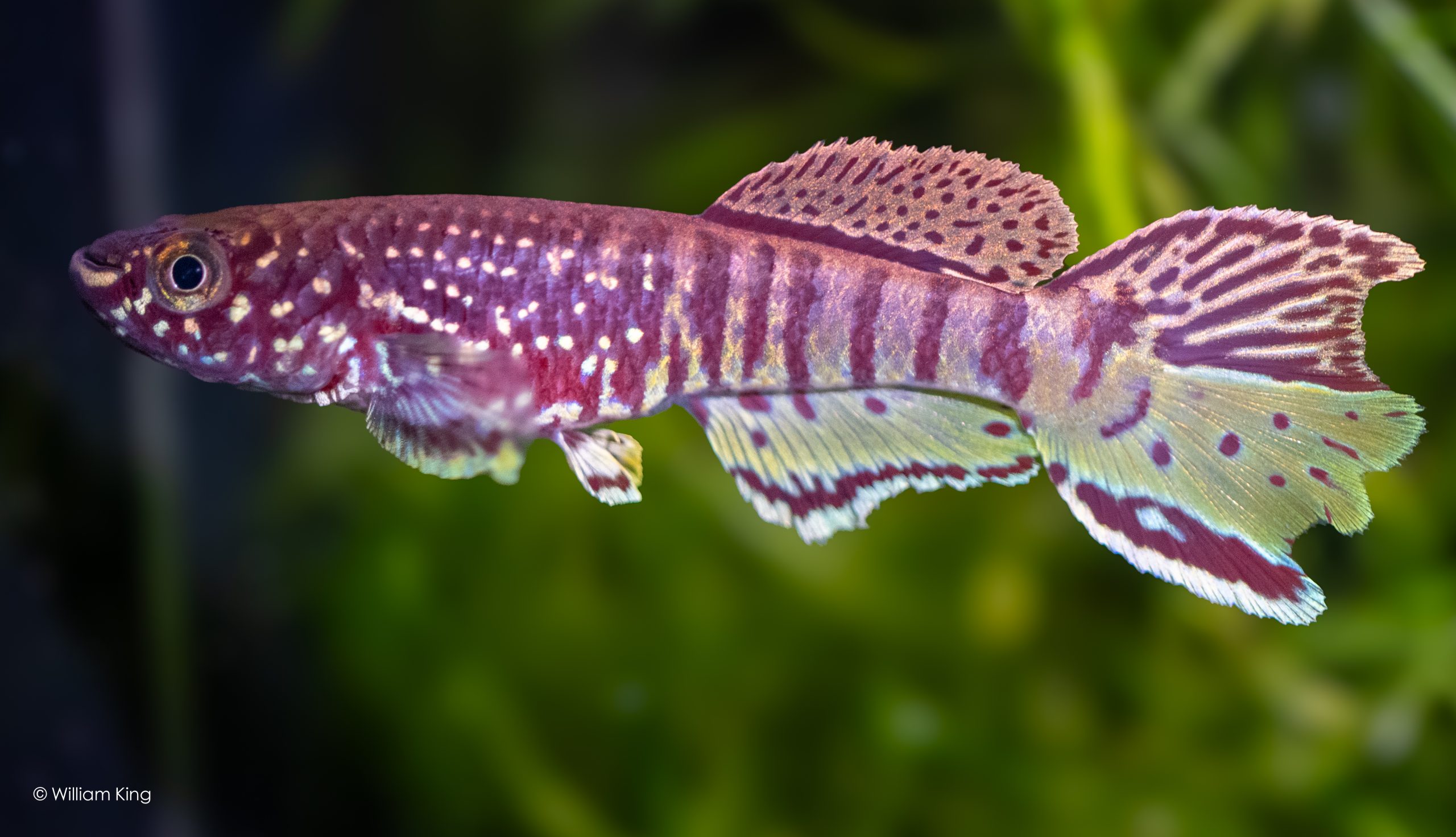
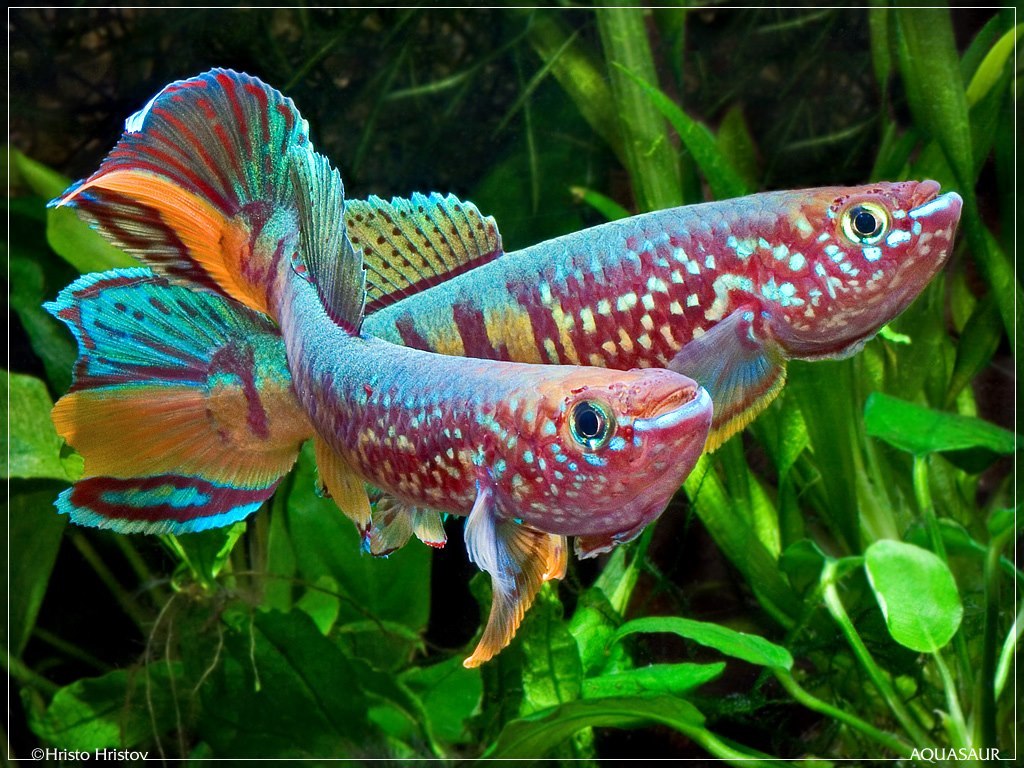
Description: Male: Upperside red-brown with an olive-green lustre, flanks green-blue, belly bluish-green to pure blue. The sides of the head and body are covered with brilliant carmine-red dots and spots which often unite into vermiform streaks and blotches. There are several transverse bands of spots, especially on the caudal peduncle which is often iridescent bluish. The dorsal fin is serrated, being blue-green to yellow-green with carmine-red spots. The upper, middle and lower rays of the caudal project into three long points and the fin itself has three sharply defined longitudinal fields. The uppermost field is green-blue with red longitudinal stripes, the centre one brilliant yellow, and the lower field sky-blue, again with longitudinal red stripes. The anal fin is blue-green, yellowish at the base, with red streaks and blotches. The ventral fins are yellowish and tipped with red. The pectoral fins are pale blue.
Female: Brown-red to greenish with red spots on the sides. The fins are yellowish-green and rounded.
Size: A good-sized male can reach five inches in length with the females a little smaller.
Feeding: A species that takes most forms of food, although live foods seem to be preferred and should be used for getting the fish into breeding condition.
Breeding: This fish is classed as a bottom spawner. It is advisable to have a trio of fish, one male and two females, they should be well matched in size. The breeding tank can be fairly small, 12″ x 8″ x 8″ being suitable. Water conditions DH 50 to 80 ppm, pH 6.5, preferably amber coloured, and with one teaspoon of salt added for each two and a half gallons of water. The spawning medium may be either well washed silver sand or peat and this should cover the bottom of the tank to a depth of approximately one inch. More conveniently it may be placed in a small open topped plastic lunch box 6″ x 3″ x 2″ which is placed in the bottom of the tank. The fish should have been separated and brought into breeding condition with a diet of live foods before being introduced into the breeding aquarium. The fish will deposit their eggs at the rate of fifty to sixty eggs per week for two or three weeks, after which time it is advisable to give them a rest. Various methods of hatching the eggs have proved successful. One method is to take the peat together with the eggs and place it in another aquarium containing similar water to which has been added acroflavine at the rate of four or five drops per gallon and then to give strong aeration for forty-eight hours to get rid of uneaten food and rubbish. The peat is then recollected and the eggs left to hatch in shallow water, this normally taking about five weeks. Alternatively, the peat may be dried out over a period of three months, after which time it is reimmersed in soft water, causing the fry to hatch out. With the silver sand method, the eggs should be separated from the sand and left to hatch in shallow trays, this again taking five weeks. However, they may be stored in moist peat for three months and then hatched out as described previously. The fry can be feed on newly hatched brine shrimp, micro worm, sieved daphnia and then on to grindal worm. With water changes the fry grow rapidly.
References:
https://www.killi-data.org/mem221bersmysql/aa-header-services221.php?Rk_Hist=392%20rel=
http://www.killifishofwestafrica.co.uk/Ref_Library/Fundulopanchax/Fp.sjoestedti.htm