Skip to content
British Killifish Association
  • Events
  • Join/Renew
    • Join/Renew
    • membermojo
  • Buy Killifish
    • Buy Killifish
    • Auction rules
  • W.Africa Killifish
    • W.Africa Killifish
    • Killifish
    • Nothobranchius A-Z
    • Eurasian Killifish
  • Killi-News
    • Killi-News
    • BKA Publications
    • Killi-News Archive search
  • Mick Agnew Fund
  • Species Maintenance
    • Species Maintenance
  • Killi-Data
    • Killi-Data
    • killi-data.org
  • Links
  • Learning
    • Beginners guide
    • Beginning with killies
    • BKA Guide to Killie Keeping
    • Chromaphyosemion History, Maintenance and Breeding
    • Nothobranchius Maintenance and Breeding
    • South American Annual Killifish Maintenance and Breeding
    • Cyprinodon (and Aphanius) Maintenance and Breeding
  • About
    • About
    • History
    • MC
    • MC Proceedings
  • Search Icon
PARAPHANIUS MENTO

PARAPHANIUS MENTO

PARAPHANIUS MENTO (Heckel 1843)

Originally published as: B.K.A. Information Pamphlet No.27 August 1967

Habitat : A species that inhabits freshwater springs and pools. Sometimes also found in lakes where it prefers the quieter spots along the shores. It is found in Anatolia (Turkey), Syria and Palestine. They are peaceful amongst themselves and with other fishes, thus making them an ideal aquarium fish for the community tank with other fishes of their own size. Males, however, may fight with each other upon occasions in competition for females. Temperature 65F. to 75F. Requires very alkaline water, preferably hard, for successful maintenance. It is relatively long-lived (up to three years with good care) and due to its wide distribution in nature, is somewhat variable in colour and pattern. A synonym for this species is Aphanius cypris.

Description : Males : The body colour is olive brown: silvery blue spots throughout the body, sometimes in vertical lines, sometimes in horizontal rows, concentrated around the gill plates, ventrum very light tan, jaw underslung ( mento meaning ‘one with long chin’). Dorsal, ventral and anal fins very dark bluish purple with distinct rows of light blue specks, caudal fin lighter and spots arranged in crescent pattern. In spawning colours, the male turns a very dark bluish purple overall (almost black) and shows an increase in the silvery spots throughout the body and fins.

Females : Light tan with rows of steel blue spots extending the length of the body, ventrum white. All fins are transparent.

Size : Males grow to two inches, with the females somewhat smaller.

Feeding : Will take dried foods, but live foods and raw meat are preferred. Filtration desirable with this species as they are heavy eaters.

Breeding : The males are fairly hard drivers and therefore should be spawned in trios, for which a two or three gallon tank is ideal. The spawning medium should be floating nylon mops. The eggs, which are clear and medium sized, hatch in seven to ten days at a temperature of 72 F. The species is very prolific, a good trio producing over 300 eggs per week at their peak. The fry are robust and take newly hatched brine shrimp immediately. Micro worms may be feed on the second week. They grow rapidly and are sexually mature in twelve to sixteen weeks. Alkaline water is advised for successful rearing of the fry.
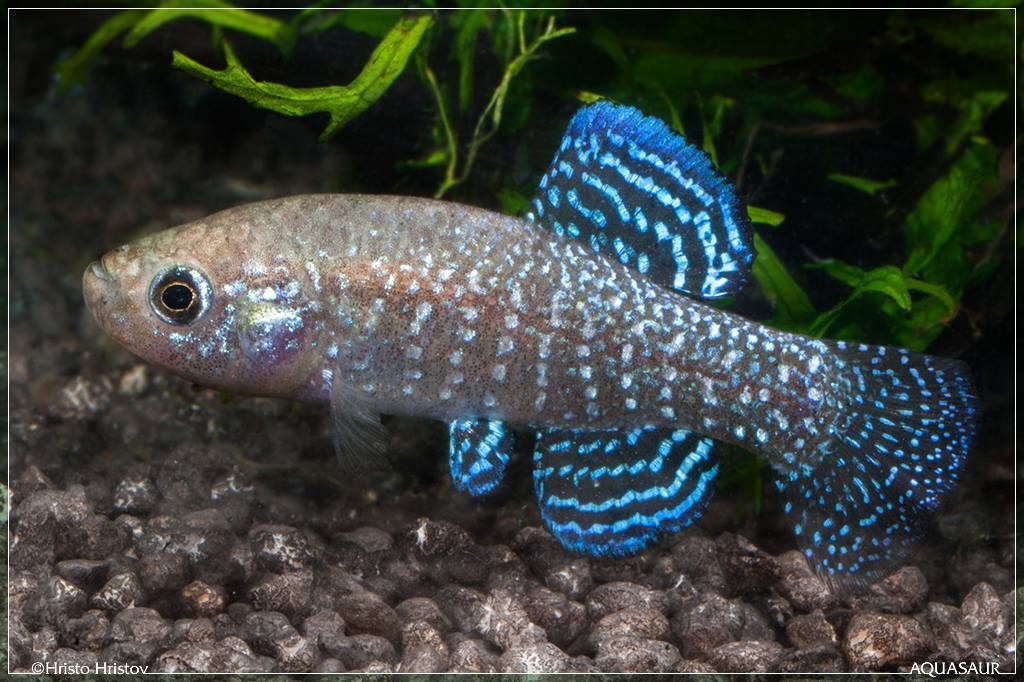
Paraphanius mento ‘Elbistan’
Paraphanius mento ‘Eregli’

Login Status

Forgot? 

Articles

  • Tim Addis’s Killifish of West Africa
  • Killi-News Archive
  • History of the BKA
  • Eurasian killifish
  • Maintenance and breeding of Cyprinodons (and Aphanius)
  • Maintenance and breeding of Nothobranchius
  • Breeding & maintenance of S.American annual Killifish
  • BKA Guide to Killie Keeping
  • The Aphyosemion subgenus Chromaphyosemion
  • First observations on the reproduction in captivity of Profundulus adani KN 625 Mar/Apr 2025
  • Uganda ’88 – Ian Sainthouse KilliNews 281-285 1989
  • Aphyosemion wachtersi and Aphyosemion buytaerti by Christian Cauvet KilliNews 585 Jul/Aug 2018
  • Paludopanchax: Charming annuals from the Gulf of Guinea countries KN 588 2019
  • Brazil 2017 by J.W.Hoetmer KilliNews Issue 591 Jul/Aug 2019
  • Return to Leticia KN 594 2020
  • COCCA 2019 by Christian Cauvet KilliNews 596 May/Jun 2020
  • A killifish adrift in the Indian Ocean by Jérôme Blanc KilliNews 610 Sept/Oct 2022
  • BKA Video Library

Live Foods

  • Infusoria
  • Microworms
  • Vinegar Eel Culture
  • Baby Brine Shrimp
  • Moina
  • Grindal worms
  • White worms
  • Fruit flies

Techniques

  • Posting Killifish
  • Beginning with Killies
  • Equipment list

Gallery

  • All
  • Aphanius and Valencia
  • Aphyoplatys
  • Aphyosemion
  • Aplocheilus
  • Archiaphyosemion
  • Austrolebias group
  • Callopanchax
  • Campellolebias
  • Chromaphyosemion
  • Cyprinodon
  • Epiplatys
  • Fundulopanchax
  • Fundulus
  • Fundulosoma
  • Gnatholebias
  • Jordanella
  • Leptopanchax
  • Lucania
  • Maratecoara
  • Micropanchax
  • Neofundulus
  • Nimbapanchax
  • Nothobranchius
  • Scriptaphyosemion
  • Simpsonichthys group
  • Pachypanchax
  • Pitunia
  • Platypanchax
  • Plesiolebias
  • Procatopus
  • Pseudepiplatys
  • Pterolebias
  • Renova
  • Rivulus group
  • Terranotus
© 2026   Copyright. British Killifish Association All Rights Reserved.